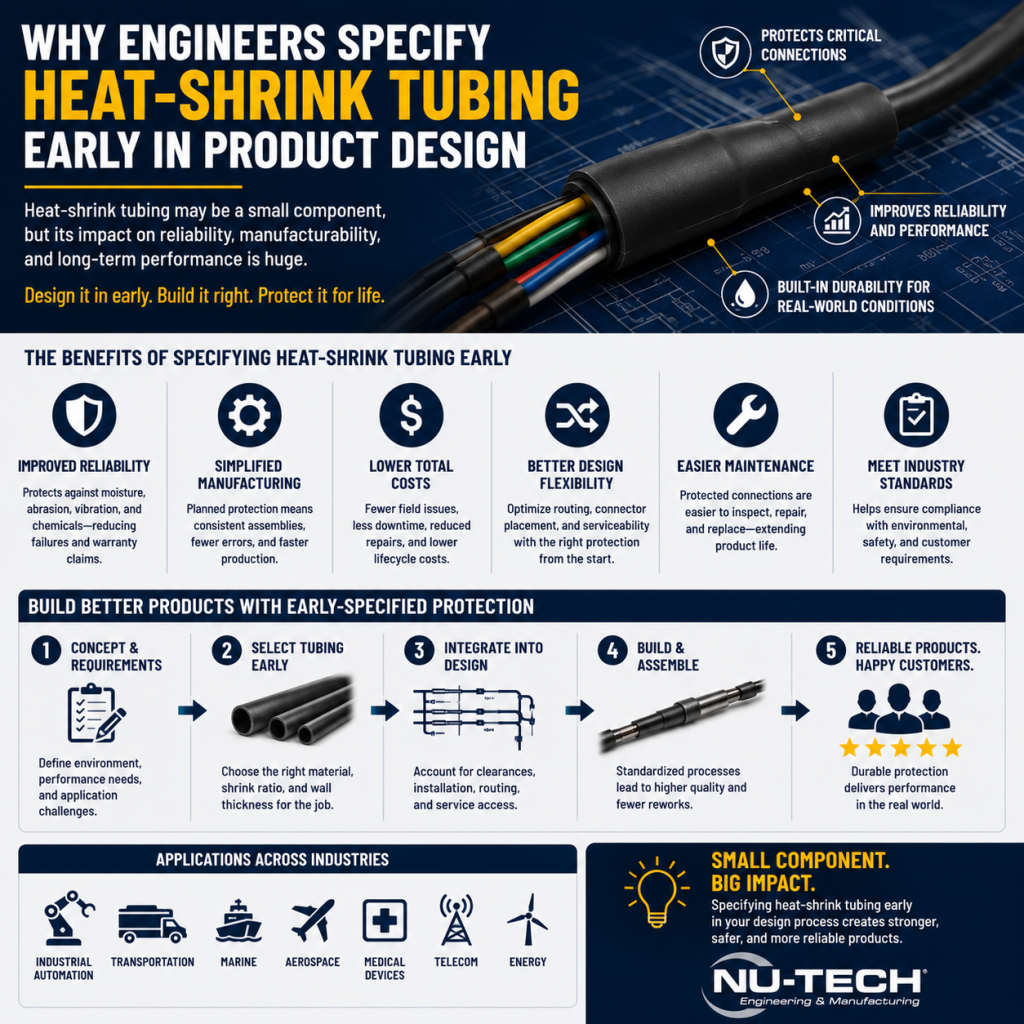
 Successful products don’t happen by accident. Every component—from major assemblies to the smallest protective materials—is carefully selected to ensure long-term performance, safety, and reliability.
One component that experienced engineers often specify early in the design process is heat-shrink tubing. While it may seem like a finishing accessory, heat-shrink tubing plays an important role in protecting electrical systems, improving manufacturability, and reducing long-term maintenance costs.
By considering cable protection from the beginning of a project, engineering teams can avoid costly redesigns and create products that perform reliably throughout their service life.
Why Early Design Decisions Matter
During product development, engineers make thousands of decisions that influence manufacturing, assembly, durability, and maintenance.
Waiting until the final stages of a project to choose cable protection can create unnecessary challenges, including:
- Limited installation space
- Improper tubing sizing
- Increased assembly time
- Higher manufacturing costs
- Reduced reliability
- Difficult maintenance procedures
By specifying heat-shrink tubing early, these issues can often be avoided before production begins.
Protecting Electrical Systems from Day One
Electrical wiring is one of the most vulnerable parts of many products.
Without adequate protection, cables and connectors may be exposed to:
- Abrasion
- Moisture
- Chemicals
- Vibration
- Mechanical stress
- Dirt and debris
Designing with heat-shrink tubing in mind allows engineers to build protection directly into the product rather than adding it later as an afterthought.
Improving Product Reliability
Every connection point represents a potential failure point.
Heat-shrink tubing helps reinforce:
- Cable terminations
- Splice locations
- Connector transitions
- Wire harness breakouts
By including these protective measures during the design phase, engineers improve the overall reliability of the finished product.
Reliable products lead to:
- Fewer warranty claims
- Less downtime
- Improved customer satisfaction
- Lower maintenance costs
Simplifying Manufacturing
Early specification benefits not only the engineering team but also manufacturing personnel.
When heat-shrink tubing is incorporated into product drawings and assembly instructions, production becomes more consistent.
Manufacturers can:
- Standardize installation procedures
- Order materials more efficiently
- Reduce assembly errors
- Improve production quality
This consistency becomes increasingly valuable as production volumes grow.
Supporting Better Wire Harness Design
Modern products often contain complex wire harnesses with multiple connectors, branch points, and cable transitions.
Planning for heat-shrink tubing during harness design helps engineers account for:
- Shrink ratios
- Wall thickness
- Connector clearances
- Cable routing
- Strain relief
- Environmental sealing
Addressing these factors early reduces the need for design revisions later in the project.
Designing for Harsh Environments
Many products operate in conditions that place significant demands on electrical systems.
Examples include:
- Heavy equipment
- Marine applications
- Aerospace systems
- Transportation
- Industrial automation
- Renewable energy
- Defense equipment
In these environments, engineers often specify heat-shrink tubing early to provide protection against:
- Moisture
- Corrosion
- UV exposure
- Abrasion
- Chemical exposure
- Temperature extremes
Early planning ensures the selected tubing matches the expected operating conditions.
Reducing Long-Term Costs
Although heat-shrink tubing represents a relatively small portion of a product’s total cost, it can have a significant impact on lifecycle expenses.
Proper cable protection helps reduce:
- Service calls
- Component failures
- Warranty repairs
- Equipment downtime
- Replacement parts
For OEM manufacturers, preventing even a small number of field failures can result in substantial cost savings over the life of a product.
Improving Serviceability
Products eventually require maintenance.
Engineers who consider cable protection early can design systems that are easier to inspect, repair, and service.
Properly planned heat-shrink installations can:
- Clearly identify cable transitions
- Protect repair locations
- Reinforce replacement connectors
- Extend cable life after maintenance
Designing with service technicians in mind often leads to lower maintenance costs throughout the product’s lifecycle.
Meeting Industry Standards
Many industries have strict requirements for electrical reliability and environmental protection.
Heat-shrink tubing can help products meet performance expectations in sectors such as:
- Aerospace
- Defense
- Medical devices
- Telecommunications
- Utilities
- Industrial manufacturing
- Transportation
Selecting the appropriate tubing during product development helps ensure compliance with customer specifications and industry requirements.
Working with Suppliers Early
Experienced engineers often collaborate with cable protection suppliers during product development rather than after the design is complete.
Early collaboration can help determine:
- Appropriate shrink ratios
- Wall thickness
- Material selection
- Adhesive-lined versus standard tubing
- Temperature ratings
- Environmental resistance
This approach reduces uncertainty while improving overall design quality.
Design Flexibility
Specifying heat-shrink tubing early also gives engineers greater flexibility.
Rather than trying to fit protection into an already finalized design, they can optimize:
- Connector placement
- Cable routing
- Harness geometry
- Installation procedures
- Manufacturing workflows
The result is a product that is easier to build, easier to maintain, and more reliable in operation.
Industries That Benefit Most
Early specification of heat-shrink tubing is especially valuable in:
- OEM manufacturing
- Industrial automation
- Automotive systems
- Marine equipment
- Aerospace
- Energy infrastructure
- Telecommunications
- Heavy machinery
In each of these industries, reliable cable protection contributes directly to product quality and long-term performance.
Conclusion
Heat-shrink tubing may appear to be a small component, but its impact on product reliability, manufacturability, and long-term performance is significant. Engineers who specify heat-shrink tubing early in the design process can simplify manufacturing, improve electrical protection, reduce maintenance costs, and build more dependable products.
By considering cable protection during the earliest stages of product development, engineering teams create designs that are better prepared for real-world operating conditions. The result is equipment that performs more reliably, lasts longer, and delivers greater value throughout its service life.
Why Engineers Specify Heat-Shrink Tubing Early in Product Design