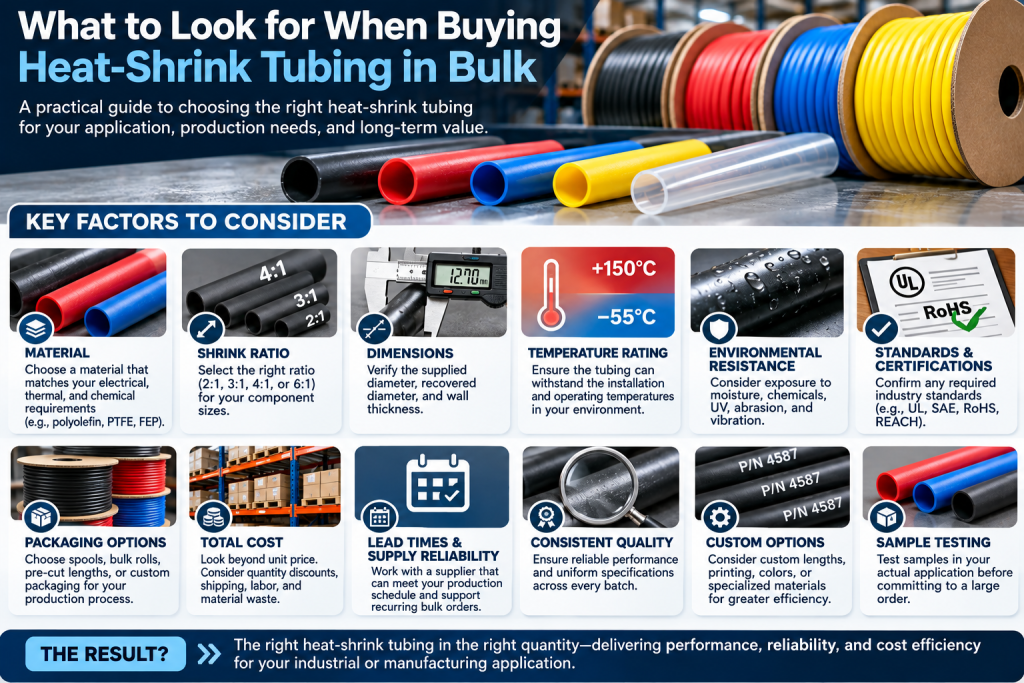
 Heat-shrink tubing is an essential component in electrical manufacturing, industrial equipment, wire harness production, and cable assembly. It provides insulation, mechanical protection, strain relief, and, in certain configurations, environmental sealing.
For manufacturers and industrial buyers, purchasing heat-shrink tubing in bulk can offer significant advantages. Larger orders may reduce per-unit costs, simplify inventory management, and help ensure that materials are available when production demands increase.
However, buying heat-shrink tubing in bulk requires more than simply finding the lowest price.
Material quality, shrink ratio, operating temperature, supplier reliability, and product consistency all influence whether a bulk purchase will deliver long-term value.
Understanding what to look for when buying heat-shrink tubing in bulk can help purchasing professionals, engineers, and manufacturers make informed decisions while avoiding costly mistakes.
Why Buy Heat-Shrink Tubing in Bulk?
Bulk purchasing is common among manufacturers that use heat-shrink tubing regularly in their production processes.
Rather than ordering small quantities whenever materials are needed, companies can purchase larger volumes to support ongoing operations.
Potential benefits include:
- Lower unit costs: Larger orders may qualify for volume-based pricing.
- Improved inventory availability: Maintaining sufficient stock can reduce the risk of production interruptions.
- Fewer purchasing transactions: Consolidating orders can reduce administrative work.
- Consistent materials: Purchasing from the same approved product specification can support manufacturing consistency.
- Simplified production planning: Predictable material availability makes it easier to schedule assembly operations.
- Reduced shipping frequency: Larger shipments may reduce the number of individual deliveries required.
These benefits are particularly valuable for companies manufacturing electrical assemblies, automotive components, industrial machinery, and other products that require repeated use of heat-shrink tubing.
However, purchasing excessive inventory can also create unnecessary storage costs and tie up working capital.
The goal is to purchase quantities that balance cost savings with actual production requirements.
1. Choose the Right Heat-Shrink Tubing Material
One of the most important considerations when buying heat-shrink tubing in bulk is material selection.
Different polymers offer different combinations of electrical, thermal, chemical, and mechanical properties.
Selecting the wrong material can result in premature deterioration, installation difficulties, or inadequate component protection.
Polyolefin Heat-Shrink Tubing
Polyolefin is among the most widely used materials for heat-shrink tubing.
It offers a useful combination of flexibility, electrical insulation, and mechanical durability.
Depending on the formulation, polyolefin tubing may be suitable for:
- Electrical wire insulation
- Cable assemblies
- Wire harness manufacturing
- Connector protection
- General industrial equipment
- Cable identification
Polyolefin is often a practical choice for bulk purchasing because of its versatility and availability.
However, not all polyolefin products have identical temperature ratings, flame-retardancy characteristics, or environmental resistance.
PTFE Heat-Shrink Tubing
Polytetrafluoroethylene (PTFE) is a fluoropolymer known for its high-temperature performance, chemical resistance, and low-friction properties.
PTFE heat-shrink tubing may be appropriate for specialized applications involving demanding operating environments.
Because PTFE products can have different installation requirements from conventional polyolefin tubing, buyers should verify compatibility with their production equipment.
FEP Heat-Shrink Tubing
Fluorinated ethylene propylene (FEP) is another fluoropolymer used in specialized heat-shrink applications.
FEP offers chemical resistance, electrical insulation, and useful temperature performance.
It may be selected for applications where conventional tubing materials do not provide the necessary properties.
Adhesive-Lined Heat-Shrink Tubing
Adhesive-lined heat-shrink tubing features an internal adhesive layer that softens during installation.
As the outer tubing contracts, the adhesive flows around the underlying component, helping create an environmental seal.
These products may be useful for applications involving moisture, contaminants, and outdoor exposure.
When purchasing adhesive-lined tubing in bulk, buyers should also consider the adhesive’s storage requirements and any manufacturer-defined shelf-life limitations.
2. Understand Heat-Shrink Tubing Shrink Ratios
Shrink ratio determines how much heat-shrink tubing can contract when heated.
It is one of the most important specifications to verify before placing a large order.
Common shrink ratios include:
- 2:1 heat-shrink tubing: The expanded diameter is approximately twice the fully recovered diameter.
- 3:1 heat-shrink tubing: The expanded diameter is approximately three times the fully recovered diameter.
- 4:1 heat-shrink tubing: The expanded diameter is approximately four times the fully recovered diameter.
- 6:1 heat-shrink tubing: A higher recovery ratio that may be useful for components with significant diameter differences.
For example, a cable assembly may require tubing to pass over a relatively large connector before shrinking around a smaller wire.
In this situation, a higher shrink ratio may provide the necessary dimensional flexibility.
When purchasing in bulk, engineers should confirm that the selected tubing can accommodate both the largest and smallest diameters in the assembly.
Ordering thousands of feet of tubing with an unsuitable shrink ratio can result in wasted material and production delays.
3. Verify Tubing Dimensions and Wall Thickness
Diameter and wall thickness are critical specifications for heat-shrink tubing.
Buyers should review the product’s supplied diameter, fully recovered diameter, and recovered wall thickness.
Supplied Diameter
The supplied diameter determines whether the tubing can fit over the component before heating.
It must provide sufficient clearance for installation, including any connectors or irregularly shaped sections.
Recovered Diameter
The recovered diameter indicates the tubing’s nominal diameter after unrestricted recovery.
The tubing must be capable of shrinking sufficiently to fit securely around the intended component.
Wall Thickness
Wall thickness influences mechanical protection, flexibility, and the finished dimensions of the assembly.
Thin-wall tubing is often suitable for compact electrical applications, while thicker-wall products may offer additional protection in demanding environments.
When ordering large quantities, dimensional consistency is particularly important.
Variation between batches can create problems for automated cutting, installation, and assembly processes.
4. Check Operating Temperature Ratings
Heat-shrink tubing must be compatible with the temperatures it will encounter during service.
Every material has an intended operating temperature range.
If tubing is exposed to temperatures beyond its rated limits, it may deteriorate prematurely.
Potential problems include:
- Cracking
- Brittleness
- Discoloration
- Loss of flexibility
- Reduced insulation performance
- Mechanical failure
Buyers should distinguish between shrink temperature and operating temperature.
Shrink temperature refers to the heat required to cause the tubing to recover during installation.
Operating temperature refers to the temperature range the tubing is designed to withstand during normal service.
These specifications are not interchangeable.
For industrial applications involving elevated temperatures, selecting appropriately rated tubing is essential.
5. Evaluate Environmental Resistance
Heat-shrink tubing is frequently used to protect components from challenging operating environments.
However, not all products offer the same resistance to moisture, chemicals, sunlight, and mechanical wear.
Before purchasing in bulk, consider whether the tubing will encounter:
- Water or humidity
- Oils and fuels
- Industrial chemicals
- Cleaning agents
- UV radiation
- Abrasion
- Vibration
- Extreme temperatures
For example, outdoor equipment may require UV-resistant tubing, while industrial machinery may require materials compatible with oils or solvents.
Applications involving moisture may benefit from adhesive-lined products designed for environmental sealing.
The selected tubing should be evaluated against the actual operating conditions rather than relying on general descriptions such as “industrial grade.”
6. Review Industry Standards and Certifications
For many industrial applications, heat-shrink tubing must meet specific performance requirements.
These may include electrical, mechanical, environmental, or flame-retardancy characteristics.
Depending on the product and application, relevant specifications may include:
- UL recognition or applicable UL requirements
- SAE aerospace material specifications
- Military or defense procurement specifications
- RoHS material compliance
- REACH regulatory requirements
- Customer-specific engineering standards
Not every heat-shrink product is certified or qualified to every standard.
Buyers should request the relevant technical documentation and confirm that the specific product meets the requirements of the intended application.
For regulated or safety-critical industries, purchasing decisions should be based on verified specifications rather than general supplier claims.
7. Consider Bulk Packaging Options
Heat-shrink tubing may be supplied in several formats, depending on the material, supplier, and order quantity.
Common packaging options include:
Continuous Spools
Spools are useful for manufacturers that cut tubing to different lengths during production.
They may be particularly suitable for automated cutting equipment or applications requiring variable lengths.
Bulk Rolls
Bulk rolls can provide an economical way to purchase larger quantities of tubing for ongoing manufacturing operations.
Pre-Cut Lengths
Pre-cut tubing can reduce preparation time by eliminating the need to measure and cut each piece during assembly.
This may be valuable for high-volume production lines.
Custom Packaging
Some suppliers may offer packaging tailored to customer requirements, including labeled bags, kits, or production-ready quantities.
The most appropriate packaging depends on how the tubing will be stored, handled, and installed.
8. Compare Total Cost, Not Just Unit Price
Price is an important consideration when purchasing heat-shrink tubing in bulk, but the lowest unit cost does not always provide the best overall value.
A less expensive product may create additional expenses if it causes installation problems, material waste, or premature failures.
When comparing suppliers, consider:
- Price per foot or meter
- Minimum order quantities
- Shipping costs
- Cutting and preparation costs
- Material waste
- Storage requirements
- Lead times
- Quality consistency
- Potential production downtime
For example, pre-cut heat-shrink tubing may have a higher purchase price than continuous tubing but reduce labor requirements during assembly.
Similarly, a higher-performance material may justify its cost if it provides better durability in the intended environment.
Evaluating the total cost of ownership helps manufacturers make more informed purchasing decisions.
9. Ask About Minimum Order Quantities
Minimum order quantities, commonly called MOQs, can vary considerably between suppliers and product types.
Standard heat-shrink tubing may be available in relatively small quantities, while custom products may require larger orders.
Factors influencing MOQs can include:
- Material type
- Tubing diameter
- Custom colors
- Printing requirements
- Specialized manufacturing
- Packaging configuration
- Production scheduling
Before placing a bulk order, buyers should confirm the minimum quantity and determine whether it aligns with their expected usage.
Ordering more tubing than necessary may reduce the unit price but increase inventory carrying costs.
For custom products, it may be worthwhile to discuss forecasted annual demand with the supplier.
10. Evaluate Supplier Reliability and Lead Times
Reliable supply is essential for manufacturers that depend on heat-shrink tubing for ongoing production.
Even a relatively inexpensive component can create significant problems if it becomes unavailable.
When evaluating suppliers, consider their ability to provide consistent product availability and dependable delivery schedules.
Important questions include:
- Are commonly used products stocked?
- What are the typical lead times?
- Can the supplier support recurring bulk orders?
- Are alternative materials or sizes available?
- Can the supplier accommodate changing production volumes?
- What happens if a product becomes temporarily unavailable?
For manufacturers with predictable demand, establishing a long-term relationship with a dependable supplier can simplify procurement and reduce supply-chain uncertainty.
11. Look for Consistent Quality Between Batches
Consistency is particularly important when heat-shrink tubing is used in automated or high-volume manufacturing.
Differences in tubing dimensions, shrink behavior, or material properties can affect production efficiency and finished product quality.
Buyers should evaluate whether suppliers maintain appropriate quality control procedures.
Depending on the application, useful documentation may include:
- Product datasheets
- Certificates of conformity
- Material traceability information
- Batch or lot identification
- Inspection records
- Relevant test results
For critical applications, sample evaluation or qualification testing may be appropriate before committing to a large purchase.
Consistent quality helps reduce manufacturing variation and supports reliable assembly performance.
12. Consider Custom Heat-Shrink Tubing Options
Standard heat-shrink tubing is suitable for many industrial applications, but some manufacturers benefit from customized products.
Customization may include:
- Precise cut lengths
- Printed identification markings
- Specialized colors
- Custom dimensions
- Application-specific materials
- Custom packaging
- Production-ready kits
For example, a wire harness manufacturer may require thousands of identical tubing sections with specific identification markings.
Purchasing these components pre-cut and pre-printed may reduce manual labor and improve assembly consistency.
Custom heat-shrink tubing can involve additional setup costs or minimum order quantities, but the benefits may outweigh those expenses in high-volume manufacturing.
13. Understand Heat-Shrink Tubing Storage Requirements
Bulk purchasing often means storing tubing for extended periods before use.
Proper storage helps preserve material properties and reduce the risk of deterioration.
Heat-shrink tubing should generally be stored according to the manufacturer’s recommendations.
Depending on the product, appropriate storage practices may include:
- Keeping tubing in a clean, dry environment
- Avoiding direct sunlight
- Preventing exposure to excessive heat
- Protecting tubing from contamination
- Maintaining original packaging where practical
- Following manufacturer-defined shelf-life requirements
Some specialized products, particularly adhesive-lined materials, may have additional storage considerations.
Inventory management practices such as first-in, first-out rotation can help prevent older materials from remaining unused indefinitely.
14. Request Samples Before Placing a Large Order
When purchasing a new heat-shrink product or changing suppliers, requesting samples can be a valuable step.
Sample testing allows engineers and production teams to evaluate the tubing under actual installation conditions.
Important factors to assess include:
- Fit over the intended component
- Shrink behavior
- Installation temperature
- Final dimensions
- Flexibility
- Appearance
- Adhesive performance, if applicable
- Compatibility with production equipment
For critical applications, additional electrical, mechanical, or environmental testing may be necessary.
Evaluating samples before committing to a large order can help identify potential problems early and reduce the risk of costly purchasing mistakes.
15. Choose a Supplier That Understands Industrial Applications
Heat-shrink tubing may appear to be a relatively simple product, but selecting the correct material requires an understanding of electrical, mechanical, and environmental requirements.
A knowledgeable supplier can help buyers compare product specifications and identify suitable options.
For industrial manufacturers, supplier support may be particularly valuable when selecting tubing for unusual dimensions, demanding operating conditions, or specialized assembly processes.
At Nu-Tech, we provide heat-shrink tubing solutions for a wide range of industrial and electrical applications.
Our product offerings include materials and configurations designed to support wire protection, insulation, identification, and specialized manufacturing requirements.
Whether you’re purchasing standard heat-shrink tubing in bulk or evaluating a more specialized solution, choosing products that meet your technical and operational needs is essential for dependable performance.
Common Mistakes to Avoid When Buying Heat-Shrink Tubing in Bulk
Before finalizing a purchase, it is useful to understand some of the most common mistakes industrial buyers make.
Choosing tubing based only on price: Lower-cost tubing may not provide the necessary durability or performance.
Ordering the wrong diameter: Tubing that is too small may not fit over components, while oversized tubing may not recover sufficiently.
Ignoring shrink ratio: An unsuitable shrink ratio can create installation problems.
Overlooking environmental conditions: Tubing that performs well indoors may not be suitable for outdoor or chemically aggressive environments.
Failing to verify specifications: Product descriptions alone may not establish compliance with application requirements.
Purchasing excessive inventory: Large orders can increase storage costs and create unnecessary material accumulation.
Skipping sample testing: A product that appears suitable on paper may not perform as expected during installation.
Avoiding these mistakes can help manufacturers improve purchasing efficiency and reduce production risks.
Final Thoughts: What to Look for When Buying Heat-Shrink Tubing in Bulk
Buying heat-shrink tubing in bulk can help manufacturers reduce costs, maintain consistent inventory, and support efficient production operations.
However, successful bulk purchasing requires careful consideration of material properties, dimensions, shrink ratios, environmental resistance, and supplier capabilities.
The best bulk heat-shrink tubing purchase is not necessarily the cheapest one. It is the one that provides the correct performance, consistent quality, and dependable availability at a reasonable total cost.
Before placing a large order, review product specifications, confirm your production requirements, and evaluate samples when appropriate.
Working with a knowledgeable supplier can also help ensure that the selected tubing meets the demands of the intended application.
For industrial buyers and manufacturers seeking dependable heat-shrink tubing solutions, Nu-Tech offers products designed for a variety of electrical and industrial requirements.
Explore Nu-Tech’s heat-shrink tubing offerings to identify materials and configurations suited to your next project.