 Electrical wires, cables, connectors, and components often need protection without sacrificing their ability to bend, move, or fit within compact assemblies. In these applications, rigid protection can create new challenges by restricting movement or placing additional stress on sensitive connections.
Flexible heat-shrink sleeving provides a practical solution.
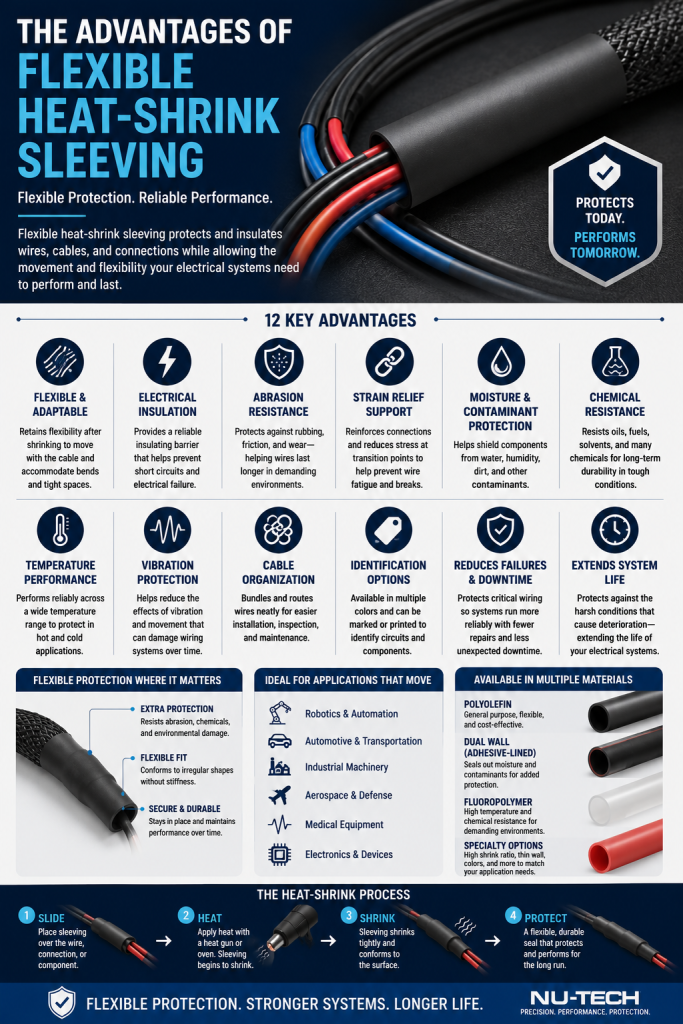
Designed to shrink securely around components while maintaining flexibility after installation, heat-shrink sleeving can provide electrical insulation, mechanical protection, strain relief, and environmental resistance without making an assembly unnecessarily rigid.
From industrial equipment and electronics to transportation, aerospace, and specialized electrical systems, flexible heat-shrink sleeving can help manufacturers create durable, reliable, and easier-to-manage cable assemblies.
What Is Flexible Heat-Shrink Sleeving?
Flexible heat-shrink sleeving is a polymer-based protective material that contracts when exposed to the appropriate amount of heat.
Before installation, the sleeving is placed over a wire, cable, splice, connector, or component. Heat is then applied, causing the material to shrink and conform closely to the underlying surface.
Unlike protective solutions designed primarily for maximum rigidity or heavy mechanical reinforcement, flexible heat-shrink sleeving is selected when the finished assembly needs to retain a useful degree of movement.
Depending on the specific material and construction, flexible heat-shrink sleeving may provide:
- Electrical insulation
- Abrasion resistance
- Mechanical protection
- Strain relief
- Moisture resistance
- Chemical resistance
- Cable organization
- Component identification
- Environmental protection
The combination of protection and flexibility makes this type of sleeving useful across a wide variety of electrical and industrial applications.
1. Protects Components Without Excessive Rigidity
One of the primary advantages of flexible heat-shrink sleeving is its ability to protect a component without making the finished assembly excessively stiff.
Wires and cables frequently need to bend during installation or operation. A protective material that is too rigid may make routing difficult or transfer mechanical stress to nearby connections.
Flexible sleeving can move with the cable while maintaining a protective covering around it.
This is particularly valuable in applications involving:
- Tight cable-routing paths
- Moving assemblies
- Compact electronic equipment
- Wire harnesses
- Flexible connections
- Equipment exposed to vibration
Manufacturers can therefore improve protection while maintaining the functionality of the original cable assembly.
2. Provides Reliable Electrical Insulation
Electrical insulation is one of the most important functions of heat-shrink products.
Exposed conductors, terminals, splices, and soldered connections can create opportunities for short circuits or unintended electrical contact if they are not properly protected.
Flexible heat-shrink sleeving creates an insulating barrier around appropriately selected electrical components.
It can be used to protect:
- Wire splices
- Terminals
- Solder joints
- Individual conductors
- Cable transitions
- Connector areas
Because different heat-shrink materials have different electrical properties, the sleeving should always be selected according to the requirements of the particular application.
3. Improves Abrasion Resistance
Electrical cables can experience substantial mechanical wear over their service lives.
A cable routed through industrial machinery, for example, may repeatedly contact a nearby surface as the equipment vibrates. Even relatively minor movement can eventually wear through conventional cable insulation.
Flexible heat-shrink sleeving provides an additional sacrificial protective layer.
Instead of the original cable jacket experiencing direct contact with an abrasive surface, the sleeving helps absorb the wear.
This can be particularly beneficial for wiring used in industrial machinery, vehicles, electronics, control systems, and other demanding environments.
4. Supports Better Strain Relief
Electrical connections are frequently most vulnerable at transition points.
Where a flexible cable meets a connector, terminal, or more rigid component, repeated bending can concentrate mechanical stress in a relatively small area.
Over time, this can contribute to broken conductors, damaged insulation, or connection failures.
Flexible heat-shrink sleeving can reinforce these transition areas while allowing controlled movement.
By distributing mechanical stress over a greater portion of the cable, the sleeving can help reduce fatigue at critical connection points.
This makes it particularly useful for applications where cables are frequently handled, moved, or subjected to vibration.
5. Makes Cable Routing Easier
Complex electrical systems can contain hundreds or even thousands of wires.
Designers must often route these cables through small openings, around other components, and through confined spaces.
Maintaining flexibility after heat-shrink installation can make these assemblies considerably easier to manage.
Flexible heat-shrink sleeving can help cables:
- Bend around components
- Fit through restricted spaces
- Follow complex routing paths
- Remain manageable during installation
- Accommodate limited movement during operation
This can be especially important in compact equipment where internal space is limited.
6. Helps Protect Against Moisture and Contaminants
Electrical components may be exposed to moisture, dust, dirt, oils, and other contaminants throughout their service lives.
Depending on the product selected, heat-shrink sleeving can provide an additional environmental barrier around vulnerable components.
For applications requiring greater sealing performance, adhesive-lined heat-shrink products may be appropriate.
When heated, the internal adhesive flows while the outer material contracts, helping fill gaps around the protected component.
This can provide additional protection in applications exposed to:
- Humidity
- Condensation
- Water
- Dirt
- Industrial contaminants
- Certain oils and fluids
The specific environmental resistance depends on the material and construction of the sleeving.
7. Performs Well in Vibration-Prone Equipment
Industrial equipment, vehicles, aircraft, pumps, motors, compressors, and other mechanical systems can generate significant vibration.
Electrical wiring installed in these environments needs to tolerate constant movement without becoming damaged.
Flexible heat-shrink sleeving can move with the cable rather than forcing the assembly to remain completely rigid.
At the same time, it provides additional protection against rubbing, mechanical stress, and wear.
This combination makes flexible sleeving valuable for electrical systems expected to operate reliably in vibration-prone environments.
8. Helps Organize Wire Harnesses
Modern wire harnesses can become complicated quickly.
Heat-shrink sleeving can help manufacturers create cleaner and more organized assemblies by protecting and grouping appropriate sections of wiring.
Different colors or markings can also be used to identify particular circuits, connections, or system functions.
Improved cable organization can benefit both manufacturing and long-term maintenance by making assemblies easier to:
- Inspect
- Identify
- Install
- Troubleshoot
- Repair
- Service
An organized wire harness is not simply more attractive—it can also make electrical systems easier to maintain.
9. Accommodates Irregular Shapes
Electrical assemblies do not always have uniform dimensions.
Connectors, terminals, splices, and transitions may create substantial differences in diameter along a cable assembly.
Heat-shrink sleeving can conform to many of these irregular surfaces as it contracts.
Selecting an appropriate shrink ratio allows the material to pass over a larger component before shrinking around smaller sections.
This capability can reduce the need for complicated protective assemblies involving multiple separate materials.
10. Helps Reduce Cable and Connection Failures
A small wiring problem can cause a much larger system to stop operating.
Common causes of electrical cable failures include:
- Abrasion
- Moisture
- Excessive bending
- Vibration
- Mechanical strain
- Damaged insulation
- Contamination
Flexible heat-shrink sleeving can help address several of these risks simultaneously.
By protecting the cable while preserving necessary movement, it can contribute to longer-lasting electrical assemblies and fewer preventable failures.
For industrial operations, greater wiring reliability can also mean reduced maintenance and less unexpected downtime.
11. Offers a Clean, Professional Finished Appearance
Heat-shrink sleeving can also improve the appearance of a finished electrical assembly.
Once properly installed, the material conforms closely to the underlying component, creating a clean and consistent finish.
This can be particularly useful for manufacturers producing equipment where wiring is visible to customers or where organized assembly is part of overall product quality.
A professional-looking electrical system can also make inspection and servicing easier by reducing loose or poorly organized wiring.
12. Supports Long-Term Product Reliability
Protecting individual electrical components contributes to the reliability of the larger system.
A sophisticated piece of industrial machinery can contain expensive motors, sensors, controllers, and electronic systems, but failure of one vulnerable connection may still bring the equipment to a stop.
Flexible heat-shrink sleeving helps protect these smaller components from the environmental and mechanical stresses they encounter over time.
The result can include:
- Longer cable life
- Fewer damaged connections
- Reduced maintenance requirements
- Improved electrical reliability
- Less unexpected downtime
- Longer equipment service life
For manufacturers, relatively small improvements in cable protection can contribute to significant long-term performance benefits.
Common Applications for Flexible Heat-Shrink Sleeving
Flexible heat-shrink sleeving is useful across many industries and applications.
Industrial Equipment
Manufacturing machinery and automation systems require durable wiring that can tolerate vibration, movement, abrasion, and demanding operating environments.
Automotive and Transportation
Vehicles contain extensive wiring systems that must fit into compact spaces while tolerating vibration, temperature changes, and continuous movement.
Aerospace
Aircraft electrical assemblies often require lightweight, dependable cable protection capable of functioning in demanding environments.
Electronics
Flexible heat-shrink sleeving can protect small connections while allowing cables to fit within compact electronic assemblies.
Medical Equipment
Medical and laboratory equipment can contain intricate wiring systems where protection, organization, and dependable performance are important.
Robotics and Automation
Robotic systems frequently combine electrical protection with movement. Flexible cable-protection solutions can be valuable where wires must move with mechanical assemblies.
Energy and Power Equipment
Electrical infrastructure, generators, control equipment, and related systems may use heat-shrink products to protect vulnerable wiring and connections.
Flexible vs. Rigid Cable Protection
Not every application requires maximum flexibility.
Some electrical systems benefit from thicker or more mechanically robust protection, particularly where impact or severe abrasion is the primary concern.
Flexible heat-shrink sleeving becomes particularly attractive when an application requires a balance between protection and movement.
Engineers should consider questions such as:
- How much must the cable bend?
- Will the assembly experience vibration?
- How much mechanical protection is required?
- Will the sleeving encounter chemicals or moisture?
- What operating temperatures will it experience?
- How tightly must it conform to the component?
The ideal product is the one that provides the required protection without unnecessarily compromising the performance of the cable assembly.
Choosing the Right Flexible Heat-Shrink Sleeving
Not all flexible heat-shrink products provide identical performance.
Several factors should be evaluated before selecting sleeving for a particular application.
Material
Material selection influences flexibility, electrical insulation, chemical resistance, temperature performance, and mechanical durability.
Shrink Ratio
The sleeving must be large enough to fit over the component before installation while shrinking sufficiently to create a secure fit.
Recovered Diameter
The final diameter after shrinking should match the dimensions of the component being protected.
Wall Thickness
Thicker materials may offer additional mechanical protection, while thinner products may provide greater flexibility or fit more easily into compact assemblies.
Operating Temperature
The sleeving should be appropriate for the temperature range expected during normal system operation.
Environmental Exposure
Engineers should consider potential contact with moisture, chemicals, oils, UV radiation, abrasion, and other environmental factors.
Adhesive Requirements
Applications requiring additional environmental sealing may benefit from adhesive-lined products.
Carefully matching these characteristics to the application helps ensure that the finished assembly receives the desired protection.
Why Flexibility Matters in Modern Electrical Systems
Modern equipment is becoming increasingly compact, interconnected, and electrically sophisticated.
Robotics, automation, sensors, control systems, vehicles, medical equipment, and industrial machinery all depend on extensive electrical connections packed into limited spaces.
Cable protection therefore needs to accomplish more than simply covering a wire.
It must help electrical assemblies survive movement, vibration, abrasion, environmental exposure, and years of regular operation—without interfering with the system they are designed to protect.
Flexible heat-shrink sleeving provides an effective balance between these requirements.
Conclusion
The greatest advantage of flexible heat-shrink sleeving is its ability to combine protection with adaptability.
It can provide electrical insulation, abrasion resistance, strain relief, environmental protection, and mechanical reinforcement while allowing cables and wiring assemblies to retain the flexibility they need.
For manufacturers and engineers, this makes flexible heat-shrink sleeving a versatile solution for industrial machinery, transportation equipment, electronics, aerospace systems, robotics, medical equipment, and many other applications.
Choosing the appropriate material, shrink ratio, wall thickness, and performance characteristics is essential, but when properly specified, flexible heat-shrink sleeving can help create electrical systems that are better protected, easier to manage, and built for long-term reliability.