 Heat-shrink tubing is widely used to protect electrical wires, cables, connectors, and other components from environmental damage. Its ability to provide insulation, abrasion resistance, and protection against moisture makes it an essential material in numerous industrial and electrical applications.
But how long does heat-shrink tubing actually last?
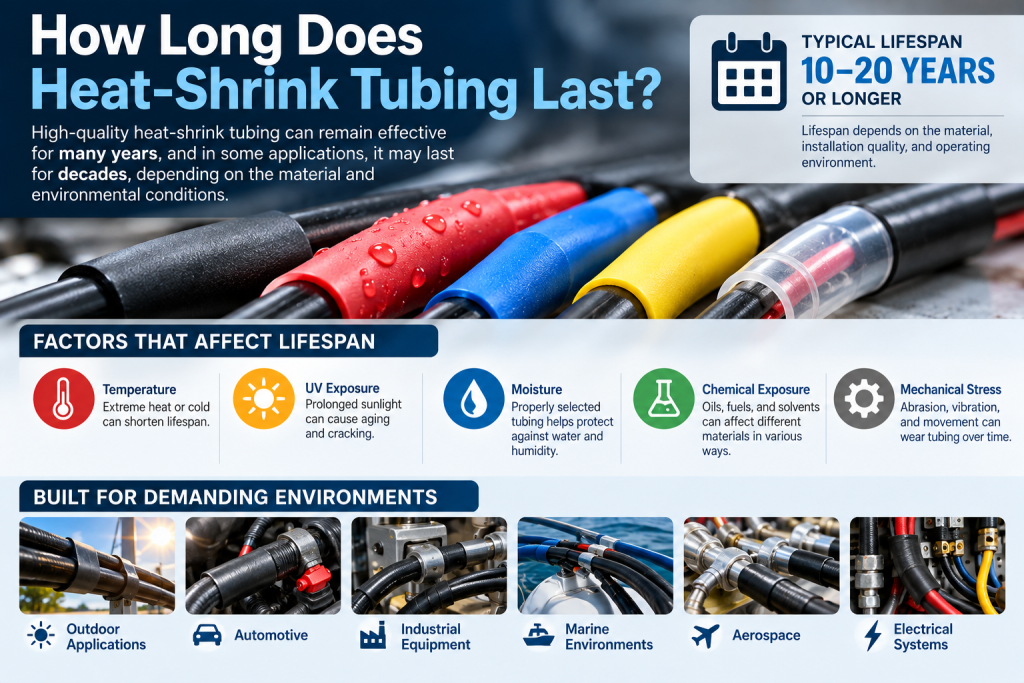
The answer depends on several factors, including the tubing material, installation quality, operating temperature, and environmental conditions. High-quality heat-shrink tubing can remain effective for many years, and in some applications, it may last for decades.
Understanding what affects the lifespan of heat-shrink tubing can help manufacturers, engineers, and maintenance professionals choose the right products and avoid premature failures.
What Is the Average Lifespan of Heat-Shrink Tubing?
There is no single lifespan that applies to every type of heat-shrink tubing.
Under favorable operating conditions, properly selected and installed heat-shrink tubing may provide 10 to 20 years of service or longer. However, this is a general illustration of potential longevity, not a guaranteed service life or universal industry rating.
Some tubing products may deteriorate much sooner when exposed to extreme temperatures, ultraviolet radiation, chemicals, or mechanical stress.
Other products, particularly those manufactured from specialized high-performance polymers, may remain effective for extended periods in demanding industrial environments.
The most important consideration is whether the tubing is designed for the conditions it will encounter throughout its service life.
What Factors Affect the Lifespan of Heat-Shrink Tubing?
Several factors influence how long heat-shrink tubing maintains its protective properties.
1. Operating Temperature
Temperature is one of the most significant factors affecting heat-shrink tubing durability.
Every heat-shrink material has a specified operating temperature range. When tubing is consistently exposed to temperatures beyond its rated limits, the material may deteriorate more quickly.
Excessive heat can cause:
- Hardening or brittleness
- Cracking and splitting
- Discoloration
- Loss of flexibility
- Reduced insulation performance
Low temperatures can also affect certain materials, particularly when the tubing is subjected to movement or vibration.
Choosing tubing with an appropriate operating temperature rating is essential for long-term reliability.
2. Exposure to UV Radiation
Heat-shrink tubing installed outdoors may experience prolonged exposure to sunlight.
Ultraviolet radiation can gradually degrade certain polymers, potentially causing discoloration, brittleness, and surface cracking.
Not all heat-shrink tubing offers the same level of UV resistance.
For outdoor applications, selecting tubing specifically rated for ultraviolet exposure can significantly improve long-term performance.
UV-resistant heat-shrink tubing is especially useful for outdoor electrical equipment, telecommunications infrastructure, and other installations exposed to sunlight.
3. Moisture and Humidity
Moisture can create serious problems for electrical connections, particularly when water reaches exposed conductors or metallic components.
Although many heat-shrink products provide a protective covering, not all heat-shrink tubing creates a waterproof seal.
Standard single-wall tubing may offer physical protection without preventing moisture from entering through its ends.
Adhesive-lined heat-shrink tubing, on the other hand, can provide additional environmental sealing when properly selected and installed.
For applications involving water, humidity, or condensation, the tubing’s sealing capabilities can directly influence the longevity of the protected assembly.
4. Chemical Exposure
Industrial environments frequently expose electrical components to oils, fuels, solvents, cleaning agents, and other chemicals.
Certain substances can cause heat-shrink tubing to swell, soften, crack, or lose its protective properties.
The level of chemical resistance depends on the polymer used to manufacture the tubing.
For example, some fluoropolymer-based heat-shrink products offer excellent resistance to a wide range of chemicals, making them suitable for demanding applications.
Before selecting tubing for an industrial environment, it is important to verify compatibility with the chemicals it may encounter.
5. Mechanical Stress and Abrasion
Heat-shrink tubing is frequently used to protect wires and cables from friction, vibration, and physical wear.
However, continuous mechanical stress can eventually damage the tubing itself.
Repeated bending, rubbing against sharp edges, or exposure to moving machinery may cause the protective material to wear down.
In applications involving significant movement or abrasion, thicker-wall or specially formulated tubing may provide better long-term protection.
Proper cable routing and strain relief can also help reduce unnecessary stress.
Does the Type of Heat-Shrink Tubing Affect Its Lifespan?
Yes. Different heat-shrink materials offer different levels of resistance to heat, chemicals, moisture, and physical damage.
Selecting the appropriate material is one of the most effective ways to improve durability.
Polyolefin Heat-Shrink Tubing
Polyolefin is one of the most commonly used materials for heat-shrink tubing.
It offers a useful combination of flexibility, electrical insulation, and mechanical protection.
Depending on its formulation, polyolefin tubing can provide reliable long-term performance in electrical wiring, cable assemblies, and industrial equipment.
However, its suitability for extreme temperatures, chemicals, and outdoor environments depends on the specific product.
Fluoropolymer Heat-Shrink Tubing
Fluoropolymer materials, including PTFE and FEP, are often selected for applications requiring specialized performance characteristics.
Depending on the material, these products may offer:
- High-temperature resistance
- Excellent chemical resistance
- Low friction
- Electrical insulation
- Resistance to harsh operating environments
These characteristics make fluoropolymer heat-shrink tubing useful in demanding industrial, aerospace, and electronic applications.
Adhesive-Lined Heat-Shrink Tubing
Adhesive-lined heat-shrink tubing contains an internal adhesive layer designed to create an environmental seal during installation.
When properly applied, the adhesive helps protect connections against moisture and contaminants.
This additional protection can help extend the service life of electrical connections in environments where water exposure is a concern.
However, the adhesive itself has temperature and material compatibility limitations that must be considered.
Does Heat-Shrink Tubing Deteriorate Over Time?
Yes. Like most polymer-based materials, heat-shrink tubing can experience gradual aging.
Even when tubing is not exposed to obvious physical damage, prolonged environmental exposure may change its mechanical or electrical properties.
For example, certain materials may become less flexible over time, while others may experience surface deterioration or reduced resistance to mechanical stress.
The rate of aging depends heavily on the tubing formulation and operating conditions.
Importantly, age alone does not necessarily mean heat-shrink tubing needs to be replaced.
Tubing that remains in good condition and continues to meet the application’s performance requirements may still be suitable for service.
How Can You Tell When Heat-Shrink Tubing Needs Replacing?
Regular inspection can help identify deterioration before it causes more serious problems.
Common warning signs include:
- Cracking: Visible cracks may indicate aging, excessive heat exposure, or mechanical damage.
- Splitting: Tubing that has split may no longer provide adequate coverage or insulation.
- Discoloration: Significant color changes can sometimes indicate overheating or environmental degradation.
- Brittleness: Tubing that has become unusually rigid may be more susceptible to cracking.
- Loose fitting: Tubing that no longer fits securely may not provide the intended protection.
- Adhesive failure: Separation or deterioration of adhesive-lined tubing can compromise environmental sealing.
- Abrasion damage: Worn areas may expose the underlying wire or component.
If heat-shrink tubing shows signs of deterioration, the affected assembly should be evaluated to determine whether replacement is necessary.
In safety-critical electrical applications, visual inspection alone may not be sufficient to establish continued suitability.
How to Make Heat-Shrink Tubing Last Longer
Although heat-shrink tubing is designed for durability, proper selection and installation can make a substantial difference in its lifespan.
Choose the Correct Material
The tubing material should be compatible with the application’s operating temperature, chemical exposure, mechanical demands, and environmental conditions.
Using a product designed for the intended environment helps reduce premature deterioration.
Select the Proper Shrink Ratio
Heat-shrink tubing must be large enough to fit over the component before installation while still recovering sufficiently to provide a secure fit.
Common shrink ratios include 2:1, 3:1, and 4:1.
Choosing the correct ratio helps ensure proper coverage without placing unnecessary stress on the material.
Avoid Overheating During Installation
Applying excessive heat can damage heat-shrink tubing before it even enters service.
Installers should follow the manufacturer’s recommended heating procedures and temperature requirements.
Controlled, even heating helps the tubing recover properly while reducing the risk of scorching, splitting, or damaging nearby components.
Protect Tubing From Unnecessary Abrasion
Where possible, avoid routing heat-shrink-covered wires against sharp metal edges or moving components.
Proper cable management, protective supports, and strain relief can help reduce wear.
Inspect Critical Assemblies Regularly
In industrial environments, routine inspection can help identify damage caused by heat, vibration, chemicals, or mechanical wear.
Inspection frequency should reflect the operating environment, equipment criticality, and applicable maintenance requirements.
Does Unused Heat-Shrink Tubing Have a Shelf Life?
Another important consideration is the difference between service life and shelf life.
Service life refers to how long tubing remains functional after installation. Shelf life refers to how long unused tubing can be stored before installation while retaining its specified properties.
Unused heat-shrink tubing can often be stored for extended periods, but storage conditions matter.
Excessive heat, direct sunlight, contamination, and improper handling may affect certain materials over time.
Some specialized products, particularly those containing adhesives, may have manufacturer-defined storage requirements or shelf-life limitations.
For best results, unused tubing should be stored according to the manufacturer’s recommendations, typically in a clean, dry environment away from excessive heat and sunlight.
Can Heat-Shrink Tubing Last Longer Than Electrical Tape?
In many applications, heat-shrink tubing can provide a more durable protective solution than conventional electrical tape.
Heat-shrink tubing forms a close-fitting covering around the underlying component without relying on a pressure-sensitive adhesive to hold overlapping layers together.
Electrical tape can loosen, unwrap, or experience adhesive deterioration under certain operating conditions.
Heat-shrink tubing, by comparison, can provide consistent coverage and mechanical protection when properly installed.
However, neither solution is universally superior.
The appropriate choice depends on the electrical, mechanical, and environmental requirements of the application.
Is Expensive Heat-Shrink Tubing Worth It?
Higher-performance heat-shrink tubing may cost more initially, but the additional expense can be justified in demanding applications.
For example, specialized tubing designed for high temperatures, chemical exposure, or environmental sealing may reduce the likelihood of premature failure.
In industrial manufacturing, replacing damaged wiring or repairing equipment can be significantly more expensive than the original protective material.
Selecting tubing based on performance requirements rather than price alone can therefore improve long-term reliability and reduce maintenance costs.
However, the most expensive product is not necessarily the best choice. The goal is to select tubing that meets the application’s actual requirements.
Choosing Long-Lasting Heat-Shrink Tubing for Industrial Applications
Heat-shrink tubing plays an important role in protecting electrical and mechanical components across numerous industries.
Whether used in manufacturing equipment, cable assemblies, telecommunications, aerospace applications, or industrial electrical systems, the correct tubing can help protect components from environmental and mechanical damage.
When selecting heat-shrink tubing, engineers and purchasing professionals should consider the material, temperature rating, shrink ratio, wall thickness, chemical resistance, and relevant industry specifications.
At Nu-Tech, we provide heat-shrink tubing solutions for a wide range of industrial and electrical applications. Selecting the right tubing for your operating environment is an important step toward achieving dependable, long-lasting performance.
Final Thoughts: How Long Does Heat-Shrink Tubing Last?
Heat-shrink tubing can last for many years, and some products may remain effective for decades under suitable conditions. However, there is no universal lifespan that applies to every material or application.
Operating temperature, UV exposure, moisture, chemicals, abrasion, and installation quality all influence how long tubing maintains its protective properties.
The best way to maximize longevity is to select a product designed for the intended environment, install it correctly, and inspect critical assemblies as needed.
For manufacturers and engineers seeking reliable heat-shrink tubing solutions, choosing the appropriate material and specifications from the beginning can help protect equipment, reduce maintenance requirements, and support long-term performance.
Explore industrial heat-shrink tubing solutions at Nu-Tech.