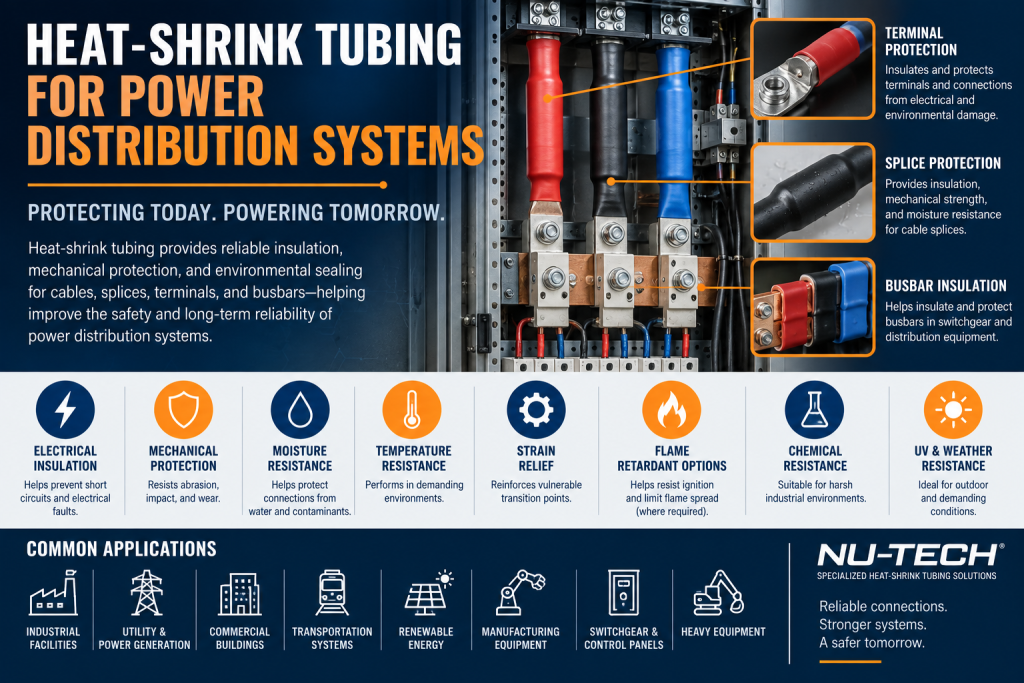
 Power distribution systems depend on reliable electrical connections. Whether electricity is being distributed throughout an industrial facility, commercial building, utility network, transportation system, or piece of heavy equipment, cables and connections must withstand electrical, mechanical, and environmental stresses throughout their service life.
Even relatively small vulnerabilities in wiring can contribute to equipment failures, unplanned downtime, or potentially hazardous electrical conditions.
Heat-shrink tubing for power distribution systems provides a practical way to insulate, protect, reinforce, and seal electrical components. With the appropriate material and specifications, heat-shrink tubing can help protect cables, splices, terminals, and connections while supporting the long-term reliability of the electrical system.
What Is Heat-Shrink Tubing?
Heat-shrink tubing is a polymer sleeve designed to contract when exposed to a specified amount of heat. The tubing is initially manufactured with a diameter large enough to fit over a cable, connection, terminal, or other component.
Once positioned, controlled heat is applied. The tubing contracts around the underlying component, creating a close-fitting protective layer.
Depending on the material and construction, heat-shrink tubing can provide several useful properties, including:
- Electrical insulation
- Mechanical protection
- Abrasion resistance
- Strain relief
- Moisture resistance
- Chemical resistance
- Environmental sealing
- Cable identification and organization
These characteristics make heat-shrink tubing useful across many electrical applications, including power distribution systems.
Why Cable Protection Matters in Power Distribution
Power distribution equipment may operate continuously for years while being exposed to demanding conditions.
Cables and connections can encounter heat, moisture, chemicals, dirt, vibration, abrasion, mechanical movement, and changing environmental conditions. Electrical components can also be affected by improper installation, aging, or physical damage.
A compromised cable or connection can become a weak point within the larger system.
Effective cable protection is therefore about more than preventing visible damage. It can contribute to the reliability and service life of the entire electrical assembly.
Heat-shrink tubing provides engineers and manufacturers with a relatively compact way to add protection precisely where it is needed.
Electrical Insulation for Power Distribution Components
Electrical insulation is one of the most important functions of heat-shrink tubing.
Conductive components must remain adequately isolated to reduce the risk of unintended electrical contact, short circuits, and other faults. Heat-shrink tubing can provide an additional insulating layer around properly designed cables, terminals, splices, and other electrical components.
This can be especially valuable in assemblies where space is limited.
Unlike bulky protective enclosures, heat-shrink tubing conforms closely to the component underneath it. Engineers can therefore add insulation and physical protection without substantially increasing the overall size of the assembly.
However, heat-shrink tubing must always be selected according to the voltage, dielectric, temperature, and other requirements of the specific application. It should complement—not replace—the electrical system’s required insulation and protection measures.
Protecting Cable Splices and Connections
Splices and connection points are particularly important areas within a power distribution system.
A continuous cable benefits from its original insulation and protective construction. Once that cable is terminated, joined, or otherwise modified, additional measures may be required to protect the connection.
Heat-shrink tubing can cover these vulnerable areas and create a consistent protective barrier around the assembly.
Depending on the application, heat shrink may be used around:
- Cable splices
- Electrical terminals
- Crimp connections
- Soldered connections
- Cable transitions
- Wire joints
- Connector interfaces
- Cable ends
Properly selected tubing can provide electrical insulation while helping protect the connection against mechanical and environmental damage.
Moisture and Environmental Protection
Water and electrical systems are rarely a good combination.
Power distribution equipment installed outdoors or in industrial environments may be exposed to humidity, condensation, rain, splashes, dust, oils, chemicals, and other contaminants.
Moisture reaching an electrical connection can contribute to corrosion and deterioration over time.
For applications requiring enhanced environmental protection, adhesive-lined heat-shrink tubing may be appropriate.
As the tubing is heated, an internal adhesive or sealant layer flows around the enclosed component while the outer tubing contracts. When correctly specified and installed, this can create a more complete environmental seal than conventional single-wall tubing.
This makes adhesive-lined heat shrink particularly useful where moisture resistance is a priority.
Abrasion and Mechanical Protection
Electrical cables are not always stationary.
Vibration, movement, maintenance activities, installation stresses, and contact with nearby components can gradually wear away at cable insulation. In industrial power distribution environments, cables may also pass through or near machinery, enclosures, brackets, and structural components.
Heat-shrink tubing can provide an additional sacrificial layer over vulnerable areas.
Rather than allowing repeated contact to directly affect the cable’s primary insulation, the heat-shrink material absorbs some of the mechanical wear.
The appropriate level of protection depends heavily on the application. Thin-wall tubing may be suitable for relatively light-duty applications, while more demanding environments can require thicker or more abrasion-resistant materials.
Providing Strain Relief
Cable termination points can experience concentrated mechanical stress.
Repeated pulling, flexing, or vibration near a connector can gradually weaken a conductor or connection. Heat-shrink tubing can help reinforce these transition areas and distribute mechanical forces across a greater portion of the cable.
This additional strain relief can be valuable in power distribution equipment exposed to vibration or frequent movement.
The tubing itself should not be treated as a substitute for a properly designed mechanical strain-relief system when one is required. Instead, it can complement the overall cable-management and connection design.
Heat-Shrink Tubing for Busbars
Heat-shrink products can also be used in certain busbar applications.
Busbars are conductive components designed to distribute substantial electrical current within switchgear, distribution equipment, control systems, and other electrical assemblies.
Specialized heat-shrink insulation can be applied to suitable busbars to provide an insulating barrier while maintaining a relatively compact profile.
Because busbars can operate at significant electrical loads, however, material selection is especially important. Voltage requirements, operating temperature, geometry, clearances, installation procedures, and applicable electrical standards all need to be considered.
Standard general-purpose heat-shrink tubing should never automatically be assumed suitable for busbar insulation.
Heat-Shrink Tubing in Electrical Cabinets and Switchgear
Power distribution systems frequently contain numerous cables and conductive components within electrical cabinets, panels, and switchgear.
Space can be limited, making compact insulation and protection valuable.
Heat-shrink tubing can be incorporated into these systems for applications such as:
- Protecting cable terminations
- Insulating appropriate electrical connections
- Reinforcing wiring at vulnerable points
- Identifying individual cables
- Color coding conductors
- Protecting certain busbar configurations
- Providing additional mechanical protection
The ability to select tubing in different materials, diameters, wall thicknesses, shrink ratios, and colors gives engineers considerable flexibility when designing power distribution assemblies.
Heat-Shrink Tubing for Industrial Power Distribution
Industrial facilities can present especially demanding conditions for electrical systems.
Factories, processing facilities, warehouses, energy installations, and heavy manufacturing operations may contain extensive power distribution infrastructure operating alongside machinery and other equipment.
Depending on the facility, electrical components may encounter vibration, elevated temperatures, chemicals, moisture, dust, and mechanical wear.
Heat-shrink tubing can be selected to address specific environmental challenges.
For example, an application exposed to industrial chemicals may require tubing with appropriate chemical resistance, while equipment located near significant heat sources may require a material with a higher operating-temperature capability.
There is no universally appropriate heat-shrink material for every industrial environment. Selection should be based on the actual conditions the component will encounter.
Heat-Shrink Tubing for Outdoor Power Applications
Outdoor power distribution presents another set of challenges.
Electrical components may experience substantial temperature changes as well as sunlight, moisture, precipitation, and environmental contamination.
Where heat-shrink tubing is intended for outdoor use, engineers should consider properties such as:
- UV resistance
- Weather resistance
- Moisture resistance
- Operating-temperature range
- Chemical resistance
- Mechanical durability
- Long-term material stability
For applications where sealing is required, appropriately specified adhesive-lined heat-shrink tubing may provide additional protection against environmental exposure.
Choosing Heat-Shrink Tubing for Power Distribution Systems
Choosing tubing based only on diameter can result in an unsuitable product.
Engineers should evaluate the electrical, mechanical, thermal, chemical, and environmental requirements of the application before selecting heat-shrink tubing.
Voltage and Electrical Properties
The material’s electrical properties must be appropriate for the intended application. Relevant specifications can include dielectric strength, insulation resistance, wall thickness, and applicable voltage ratings.
Operating Temperature
Power distribution components can generate heat during operation. Ambient temperatures may also vary significantly.
Heat-shrink tubing should maintain its required properties throughout the expected operating-temperature range.
Shrink Ratio
The shrink ratio describes the relationship between the tubing’s supplied diameter and its recovered diameter.
Common ratios include 2:1, 3:1, and 4:1, although other configurations are available.
Higher shrink ratios can be useful when the tubing needs to pass over a relatively large connector or component before shrinking around a smaller cable.
Recovered Diameter
Once fully shrunk, the tubing needs to fit securely around the underlying component.
Both the supplied diameter and fully recovered dimensions should therefore be considered when specifying tubing.
Wall Thickness
Wall thickness affects the physical and electrical characteristics of the finished installation.
Thin-wall products can provide lightweight, flexible protection, while thicker tubing may be selected where greater mechanical or insulating performance is necessary.
Flame-Retardant Properties
In some power distribution environments, flame retardancy is an important consideration.
Flame-retardant heat-shrink tubing is formulated to resist ignition or continued flame propagation according to specified test conditions. Where required, engineers should verify that the selected product satisfies the applicable flame-performance requirements.
Environmental Resistance
The operating environment can be just as important as the electrical requirements.
Potential exposure to water, chemicals, oils, fuels, sunlight, abrasion, or other contaminants should be considered during material selection.
The Importance of Proper Installation
Even correctly specified heat-shrink tubing can perform poorly if it is improperly installed.
The tubing should be cut to the appropriate length and positioned before heat is applied. Controlled, even heating allows the material to recover uniformly around the component.
Excessive heat may damage the tubing or underlying cable, while insufficient or uneven heating can result in incomplete recovery.
For adhesive-lined products, proper installation is particularly important because the adhesive must flow appropriately to form the intended seal.
Installers should always follow the tubing manufacturer’s recommendations regarding heating temperature, installation method, recovery, and cooling.
Supporting Long-Term Power Distribution Reliability
Reliable power distribution requires attention to components both large and small.
Transformers, switchgear, circuit protection, conductors, connectors, and control equipment may represent the most visible parts of a distribution system, but seemingly minor protective components can also influence long-term reliability.
Heat-shrink tubing can help protect vulnerable electrical connections against insulation failure, abrasion, moisture, mechanical stress, and environmental exposure.
By protecting these areas before problems develop, engineers and manufacturers can help reduce avoidable deterioration and support longer component service life.
A Small Component with an Important Role
Heat-shrink tubing is a relatively simple product, but its role in power distribution systems can be significant.
The right tubing can provide electrical insulation, reinforce connections, protect against abrasion, provide strain relief, improve environmental resistance, and help safeguard components against demanding operating conditions.
The key is selecting the product based on the complete application.
Voltage, temperature, shrink ratio, wall thickness, material composition, flame-retardant characteristics, chemical resistance, environmental exposure, and mechanical requirements should all be evaluated when necessary.
With the right combination of material selection and proper installation, heat-shrink tubing for power distribution systems can contribute to safer, more durable, and more reliable electrical infrastructure.