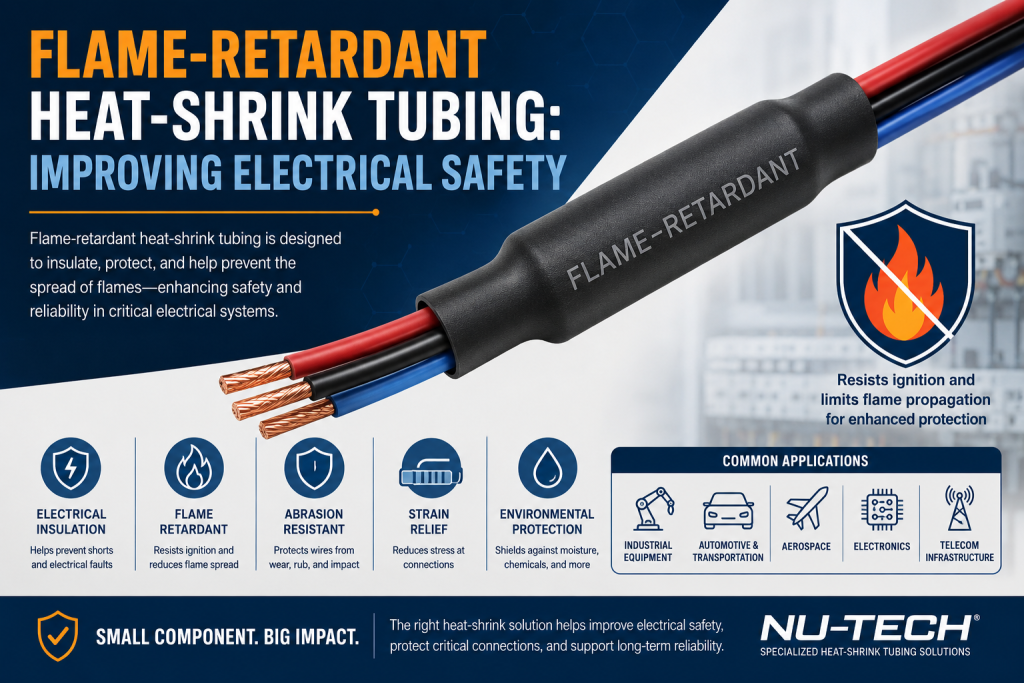
 Electrical systems are found throughout industrial equipment, vehicles, electronics, telecommunications infrastructure, aerospace systems, and countless other applications. Wherever electrical wiring is present, protecting wires, cables, splices, and connections from damage is an important part of maintaining long-term safety and reliability.
One solution is flame-retardant heat-shrink tubing. In addition to providing insulation and physical protection, flame-retardant heat-shrink tubing is designed to resist ignition and limit the spread of flames under specified conditions.
For manufacturers and engineers working with electrical components, choosing the appropriate heat-shrink material can help improve electrical safety while protecting sensitive components from demanding operating environments.
What Is Flame-Retardant Heat-Shrink Tubing?
Heat-shrink tubing is a polymer sleeve manufactured to contract when exposed to the appropriate amount of heat. Before shrinking, the tubing can be positioned over a wire, cable, splice, terminal, or other component. Heat is then applied, causing the tubing to shrink tightly around the underlying component.
Depending on its material and construction, heat-shrink tubing can provide:
- Electrical insulation
- Abrasion resistance
- Strain relief
- Environmental protection
- Wire and cable organization
- Mechanical protection
- Identification and color coding
Flame-retardant heat-shrink tubing provides an additional safety characteristic: it is formulated to resist combustion or reduce the continued spread of flames after exposure to an ignition source.
It is important to distinguish between flame-retardant and fireproof. Flame-retardant tubing can still be damaged by sufficiently intense or prolonged heat. Its purpose is generally to reduce ignition, flame propagation, or continued burning according to the characteristics and ratings of the particular product.
Why Flame Retardancy Matters in Electrical Systems
Electrical equipment can encounter numerous sources of heat. Overloaded circuits, damaged conductors, loose connections, component failures, electrical arcing, and nearby heat-generating equipment can all create potentially dangerous conditions.
A small electrical fault can become considerably more serious if surrounding materials readily support combustion.
This makes material selection an important consideration when designing electrical assemblies. Using flame-retardant materials around wiring and connections can contribute to a system’s overall approach to fire safety.
Heat-shrink tubing is especially useful because it can combine this characteristic with several other forms of protection in a relatively compact package.
Improving Electrical Insulation
One of the fundamental purposes of heat-shrink tubing is electrical insulation.
Exposed conductors and poorly protected connections can create opportunities for short circuits and other electrical failures. Properly selected and installed heat-shrink tubing creates a protective insulating layer around the component.
This can be particularly valuable around:
- Wire splices
- Terminals
- Connectors
- Soldered joints
- Cable transitions
- Electrical repairs
Flame-retardant tubing adds another layer of protection by using a material specifically selected for its behavior when exposed to flame.
Helping Limit Flame Propagation
The ability to resist flame propagation is one of the primary reasons manufacturers choose flame-retardant heat-shrink tubing.
In tightly packed electrical assemblies, wires and cables can run alongside numerous other components. If a material ignites and continues burning, flames may potentially spread to adjacent parts of the system.
Flame-retardant tubing is designed to reduce this risk by resisting sustained combustion under specified conditions.
This characteristic can be particularly important in equipment containing dense wiring, where even relatively small electrical components may be located close to other potentially combustible materials.
Protecting Wires Against Abrasion
Electrical safety isn’t exclusively about fire.
Repeated rubbing, vibration, movement, or contact with sharp surfaces can gradually damage wire insulation. Once the underlying conductor becomes exposed, the risk of electrical faults increases.
Heat-shrink tubing provides an additional physical barrier around vulnerable sections of wiring.
This can make it useful in applications involving machinery, vehicles, industrial equipment, electronics, and other environments where components may experience movement or mechanical stress.
Preventing physical damage in the first place can reduce the likelihood of electrical problems developing later.
Providing Strain Relief
Electrical connections can also fail because of repeated bending or pulling.
The point where a flexible wire meets a relatively rigid connector is particularly vulnerable. Repeated movement can place stress on the conductor or connection until it eventually becomes damaged.
Properly selected heat-shrink tubing can reinforce these transition points and provide additional strain relief.
This helps distribute mechanical stress across a larger area rather than concentrating it at a single vulnerable point.
When flame-retardant properties are also required, specialized heat-shrink tubing can provide both mechanical support and improved fire-safety characteristics.
Supporting Protection in Harsh Environments
Electrical components don’t always operate in clean, climate-controlled environments.
Industrial and transportation applications may expose wiring to moisture, dirt, chemicals, oils, vibration, temperature changes, and other environmental challenges.
Different heat-shrink materials offer different levels of resistance to these conditions. Some products are designed specifically for demanding environments, while adhesive-lined varieties can provide additional sealing around the enclosed component.
Selecting tubing that matches the application’s environmental requirements can help preserve the integrity of electrical connections over time.
Flame retardancy can then become one part of a broader protection strategy that also considers temperature, chemicals, moisture, mechanical wear, and other operating conditions.
Common Applications for Flame-Retardant Heat-Shrink Tubing
Because electrical wiring is used across so many industries, flame-retardant heat-shrink tubing can be suitable for a wide range of applications.
Industrial Equipment
Factories and industrial facilities often contain extensive electrical systems operating alongside motors, machinery, heating equipment, and other potential sources of heat.
Flame-retardant tubing can help protect connections and wiring within control systems, machinery, electrical cabinets, and other industrial equipment.
Automotive and Transportation
Modern vehicles contain increasingly complex electrical systems.
Heat-shrink tubing can be used to protect wiring harnesses, connections, sensors, and other electrical components against vibration and abrasion. Where flame-retardant characteristics are required, appropriately rated tubing can provide additional protection.
Aerospace
Aerospace electrical systems demand careful material selection because reliability, weight, space, temperature performance, and safety can all be critical considerations.
Specialized heat-shrink products can be selected according to the particular requirements of aerospace wiring and electrical assemblies.
Electronics Manufacturing
Compact electronic equipment can contain large numbers of wires, connectors, and components in a relatively small space.
Heat-shrink tubing allows manufacturers to insulate and protect individual connections without requiring bulky protective structures.
Telecommunications
Communications infrastructure relies on large networks of cables and connections that need to remain protected throughout their operating life.
Heat-shrink products can provide insulation, organization, mechanical protection, and environmental resistance for suitable telecommunications applications.
Choosing the Right Flame-Retardant Heat-Shrink Tubing
Not every flame-retardant heat-shrink product offers the same properties. Manufacturers and engineers should evaluate the complete requirements of an application before choosing a material.
Important considerations can include:
Shrink ratio: The shrink ratio determines how much the tubing can contract relative to its original diameter. Common ratios include 2:1, 3:1, and higher ratios for specialized applications.
Operating temperature: Tubing should be capable of handling the temperatures it will encounter throughout normal operation.
Flammability requirements: Different industries and applications may require specific flame-retardancy classifications, testing methods, or certifications.
Electrical properties: Dielectric strength and other electrical characteristics should be appropriate for the intended application.
Chemical resistance: Exposure to fuels, oils, solvents, cleaning agents, or industrial chemicals may require a particular polymer formulation.
Mechanical requirements: Abrasion resistance, flexibility, toughness, and strain-relief requirements can influence material selection.
Environmental exposure: Moisture, UV radiation, weather, and other environmental conditions should also be considered where applicable.
The correct tubing is therefore not simply the product that fits around the wire. It is the material whose overall properties match the electrical, mechanical, environmental, and safety requirements of the application.
Proper Installation Is Essential
Even high-quality heat-shrink tubing needs to be installed correctly to perform as intended.
The tubing should first be sized appropriately for both the component’s original dimensions and its final recovered diameter. It should then be positioned correctly before controlled heat is applied.
Uneven heating, excessive temperatures, insufficient recovery, or incorrect sizing can produce an inadequate fit or potentially damage the tubing and underlying components.
Following the manufacturer’s recommended installation procedures helps ensure the tubing achieves its intended performance.
Flame Retardancy as Part of a Larger Safety Strategy
Flame-retardant heat-shrink tubing should not be treated as a substitute for proper electrical design.
Circuit protection, suitable conductor sizing, effective thermal management, appropriate connectors, correct installation, maintenance, and compliance with applicable standards all remain essential.
Instead, flame-retardant heat-shrink tubing can serve as one component of a layered electrical-safety strategy.
A well-designed electrical system attempts to prevent failures while also limiting the consequences if a failure occurs. Protective materials can contribute to that second line of defense.
Improve Electrical Protection with the Right Heat-Shrink Solution
Small components can play an important role in the reliability and safety of a larger electrical system.
Flame-retardant heat-shrink tubing combines the practical advantages of conventional heat-shrink protection with materials designed to resist ignition or continued flame propagation under specified conditions. Depending on the product, it can help provide insulation, abrasion resistance, strain relief, environmental protection, and enhanced flame resistance in a single solution.
The key is selecting tubing according to the actual requirements of the application rather than relying on a one-size-fits-all approach.
Nu-Tech specializes in heat-shrink tubing and sleeving solutions for a wide variety of industrial and manufacturing applications. Whether an application requires electrical insulation, mechanical protection, environmental resistance, or specialized performance characteristics, choosing the appropriate material can help improve the safety and longevity of critical components.
Flame-Retardant Heat-Shrink Tubing: Improving Electrical Safety