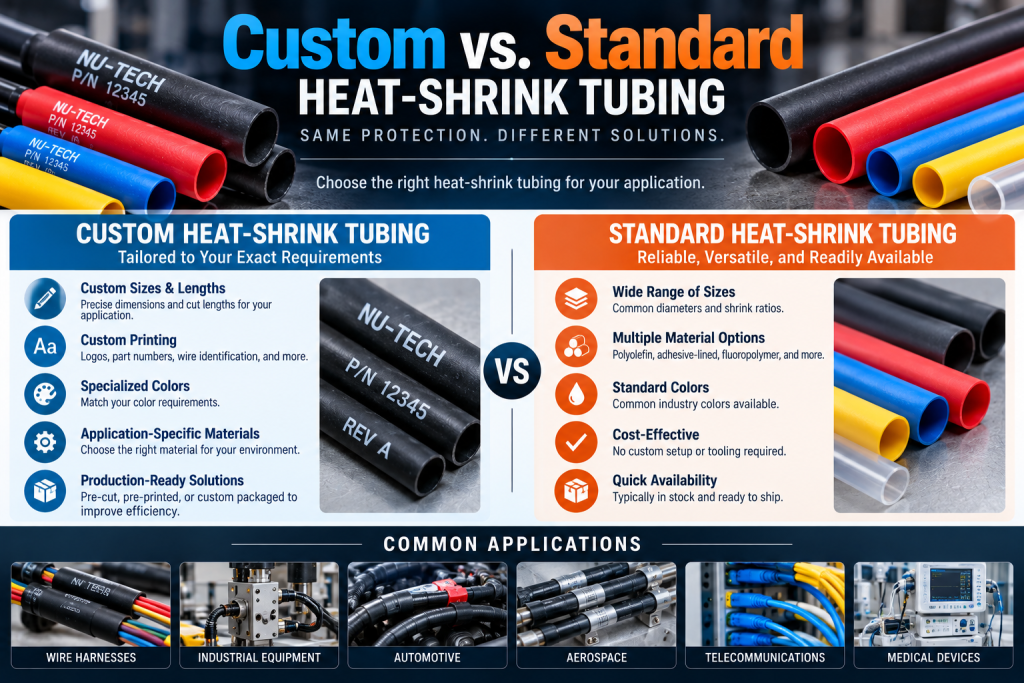
 Heat-shrink tubing is an essential component in countless electrical, industrial, and manufacturing applications. From protecting wire connections to providing insulation, strain relief, and environmental protection, heat-shrink tubing helps improve the durability and reliability of electrical assemblies.
However, not every application has the same requirements.
While standard heat-shrink tubing is suitable for many common uses, some projects require specialized dimensions, materials, colors, markings, or performance characteristics.
This raises an important question: Should you choose custom or standard heat-shrink tubing?
Understanding the differences between these options can help engineers, manufacturers, and purchasing professionals select the most practical and cost-effective solution.
What Is Standard Heat-Shrink Tubing?
Standard heat-shrink tubing refers to commercially available products manufactured in established sizes, materials, shrink ratios, and configurations.
These products are designed to accommodate a wide range of common electrical and industrial applications.
Standard heat-shrink tubing is typically available in various diameters, wall thicknesses, colors, and materials, allowing users to select products that meet their requirements without requesting specialized manufacturing.
Common applications include:
- Electrical wire insulation
- Cable and connector protection
- Wire harness assembly
- Strain relief
- Cable identification
- Abrasion resistance
- Environmental protection
Standard products are often available in bulk rolls, spools, or pre-cut lengths, depending on the supplier.
Because these products are manufactured in established configurations, they are generally easier to source and may offer shorter lead times than custom solutions.
What Is Custom Heat-Shrink Tubing?
Custom heat-shrink tubing refers to tubing that has been manufactured, modified, processed, or supplied according to specific customer requirements.
Customization can involve relatively simple changes, such as cutting tubing to precise lengths or printing identification markings.
More complex customization may involve specialized dimensions, material formulations, colors, wall thicknesses, or performance requirements.
Examples of custom heat-shrink tubing solutions include:
- Custom-cut tubing lengths
- Printed identification markings
- Specialized colors
- Application-specific diameters
- Nonstandard wall thicknesses
- Specialized material requirements
- Custom packaging and labeling
- Preassembled tubing components
The extent of customization available depends on the manufacturer’s capabilities, the selected material, and production requirements.
Custom tubing is particularly valuable when standard products cannot adequately meet the dimensional, operational, or production needs of an application.
Custom vs. Standard Heat-Shrink Tubing: Key Differences
Although both options serve similar protective purposes, several important differences can influence the selection process.
| Feature | Standard Heat-Shrink Tubing | Custom Heat-Shrink Tubing |
|---|---|---|
| Availability | Often readily available | May require additional production time |
| Dimensions | Established sizes and lengths | Can accommodate specialized requirements |
| Materials | Common commercially available options | May include application-specific selections |
| Identification | Standard colors and markings | Custom printing, colors, or labels |
| Initial cost | Generally lower | May involve setup or tooling costs |
| Order quantities | Often flexible | May require minimum order quantities |
| Production efficiency | May require additional processing | Can arrive ready for specific assembly operations |
| Best suited for | General-purpose and common industrial applications | Specialized equipment, OEM production, and unique assemblies |
Neither option is automatically superior.
The best choice depends on the technical requirements, production volume, budget, and intended operating environment.
Advantages of Standard Heat-Shrink Tubing
Standard heat-shrink tubing remains the preferred solution for many applications because of its versatility, availability, and cost-effectiveness.
1. Faster Availability
One of the primary advantages of standard heat-shrink tubing is that commonly used products may already be available from supplier inventory.
This can reduce procurement delays and make standard tubing particularly useful for maintenance, repairs, and projects with short deadlines.
2. Lower Initial Costs
Standard heat-shrink tubing generally does not require the additional setup, engineering, or tooling expenses sometimes associated with customized products.
For small orders or straightforward applications, this can make standard tubing the more economical choice.
3. Wide Range of Options
Standard heat-shrink tubing is available in numerous materials, sizes, and configurations.
Common options include polyolefin, adhesive-lined tubing, fluoropolymer tubing, and specialized products designed for particular environmental conditions.
In many cases, a standard product can meet demanding technical requirements without customization.
4. Simplified Procurement
Using established products can simplify purchasing, inventory management, and replacement procedures.
When a standard product meets the necessary specifications, it may be easier to maintain consistent inventory and source additional quantities.
Advantages of Custom Heat-Shrink Tubing
Custom heat-shrink tubing can offer important benefits when an application has unique requirements or when production efficiency is a priority.
1. Precise Application Requirements
Some electrical assemblies involve unusual component dimensions, limited installation space, or specialized performance requirements.
Custom tubing may help accommodate these needs more effectively than standard products.
For example, an OEM manufacturer may require tubing supplied in precise lengths to ensure consistent assembly across thousands of components.
2. Reduced Assembly Time
Custom-cut heat-shrink tubing can eliminate the need for workers to measure and cut tubing during production.
For high-volume manufacturing operations, even small reductions in assembly time can produce meaningful efficiency improvements.
Pre-cut tubing can also help reduce variation between finished assemblies.
3. Improved Identification
Custom-printed heat-shrink tubing can include identification numbers, component labels, circuit information, or other markings.
This can be particularly useful in complex electrical systems where accurate wire identification is essential.
Printed tubing may help simplify installation, maintenance, troubleshooting, and quality control.
4. Reduced Material Waste
When standard tubing is supplied in long lengths, manufacturers may need to cut individual pieces during assembly.
Depending on the process, this can generate offcuts and increase material handling.
Custom-cut tubing can help reduce unnecessary waste by providing lengths matched to the production requirements.
5. Better Integration Into Manufacturing Processes
For manufacturers producing large quantities of identical components, customized tubing can support standardized assembly procedures.
Consistent lengths, markings, and packaging can help reduce handling time and improve production organization.
These benefits may offset the additional costs associated with customization.
When Should You Choose Standard Heat-Shrink Tubing?
Standard heat-shrink tubing is often the most practical choice when the application does not require specialized dimensions or processing.
It may be particularly suitable for:
- General electrical repairs
- Maintenance and replacement work
- Small production runs
- Prototyping
- Standard wire harness assemblies
- Routine cable protection
- Applications using common wire and connector sizes
For example, a maintenance technician replacing damaged insulation on an industrial cable may only need a standard polyolefin heat-shrink product with the appropriate diameter and temperature rating.
In this situation, ordering a custom product would likely provide little additional value.
Standard tubing can also be an excellent choice for demanding industrial environments when an existing product already meets the required specifications.
When Should You Choose Custom Heat-Shrink Tubing?
Custom heat-shrink tubing becomes particularly valuable when the application requires features that are unavailable or impractical with standard products.
High-Volume Manufacturing
Manufacturers producing thousands of identical assemblies may benefit from tubing supplied in predetermined lengths.
This reduces manual preparation and can improve consistency across production batches.
Complex Wire Harnesses
Large wire harnesses may contain numerous connections requiring identification.
Custom-printed tubing can help distinguish individual wires and simplify installation or servicing.
Specialized Industrial Equipment
Certain machines and components may have unusual dimensional requirements.
Custom tubing can help accommodate these configurations when standard sizes do not provide an acceptable fit.
OEM Applications
Original equipment manufacturers often require components that integrate smoothly into established production processes.
Custom tubing may be supplied with specific markings, dimensions, packaging, or documentation to support these requirements.
Specialized Environmental Requirements
Some applications require particular combinations of temperature resistance, chemical compatibility, flexibility, and mechanical protection.
In these cases, specialized tubing may be necessary.
However, manufacturers should first determine whether an existing high-performance product already meets the requirements before pursuing a fully customized solution.
Does Custom Heat-Shrink Tubing Cost More?
Custom heat-shrink tubing often involves higher initial costs than comparable standard products.
These additional expenses may include:
- Engineering and design
- Specialized manufacturing
- Printing setup
- Cutting and processing
- Tooling
- Quality testing
- Custom packaging
Minimum order quantities may also apply.
However, the purchase price of the tubing is only one part of the total cost.
For high-volume manufacturing, custom-cut or pre-printed tubing may reduce labor, material waste, and assembly time.
For example, if workers must manually measure, cut, and label thousands of tubing sections, those preparation steps add time and cost to the production process.
Receiving tubing already prepared for installation can reduce those expenses.
As a result, custom heat-shrink tubing may be more cost-effective over the entire manufacturing process, even when its initial purchase price is higher.
The actual savings depend on production volume, labor requirements, and the type of customization.
How Does Shrink Ratio Affect Custom and Standard Tubing?
Shrink ratio is an important consideration regardless of whether tubing is custom or standard.
The shrink ratio describes the relationship between the tubing’s expanded diameter and its fully recovered diameter.
Common ratios include:
- 2:1: The expanded diameter is approximately twice the fully recovered diameter.
- 3:1: The expanded diameter is approximately three times the fully recovered diameter.
- 4:1: The expanded diameter is approximately four times the fully recovered diameter.
Higher shrink ratios can be useful when tubing must fit over a large connector and then shrink tightly around a smaller cable.
Both standard and custom products may be available with different shrink ratios, depending on the material and manufacturing capabilities.
When selecting tubing, engineers should consider the largest diameter the tubing must pass over and the smallest diameter it must securely cover.
Choosing the correct shrink ratio is essential for proper installation and long-term performance.
Material Selection: Custom vs. Standard Heat-Shrink Tubing
Material selection is another important factor in determining which tubing solution is appropriate.
Different polymers offer different levels of resistance to temperature, chemicals, moisture, and mechanical stress.
Polyolefin
Polyolefin is widely used for general electrical insulation and cable protection.
It offers flexibility and useful mechanical and electrical properties, making it suitable for many standard applications.
Specialized polyolefin formulations may also be available for more demanding requirements.
PTFE
Polytetrafluoroethylene (PTFE) is a fluoropolymer known for its high-temperature capabilities, chemical resistance, and low-friction properties.
PTFE heat-shrink tubing may be appropriate for specialized industrial and electrical applications.
FEP
Fluorinated ethylene propylene (FEP) offers chemical resistance, electrical insulation, and useful temperature performance.
It may be selected for applications requiring specialized protective properties.
Adhesive-Lined Tubing
Adhesive-lined heat-shrink tubing incorporates an internal adhesive layer that softens during installation.
When properly applied, this can help create an environmental seal around the underlying component.
The appropriate material depends on the application’s actual operating conditions rather than whether the tubing is classified as standard or custom.
What Industries Benefit From Custom Heat-Shrink Tubing?
Custom heat-shrink tubing can provide advantages across numerous industries.
Aerospace: Specialized cable assemblies may require precise identification, dimensional consistency, and materials that meet demanding specifications.
Automotive: High-volume wire harness manufacturing can benefit from pre-cut tubing and standardized identification.
Industrial Manufacturing: Custom lengths and packaging can support repeatable production processes and reduce material handling.
Telecommunications: Printed tubing can simplify cable identification and maintenance in complex installations.
Medical Equipment: Certain assemblies may require specialized dimensions, materials, or documented performance characteristics.
Electronics: Compact components and intricate assemblies may benefit from carefully selected tubing dimensions and wall thicknesses.
In each industry, the final product must meet applicable technical, regulatory, and quality requirements.
Customization alone does not guarantee compliance with industry standards.
How to Choose Between Custom and Standard Heat-Shrink Tubing
Before deciding which option to purchase, engineers and purchasing professionals should evaluate several questions.
1. Does a standard product meet the technical requirements?
If an existing product provides the correct dimensions, material properties, and performance, customization may be unnecessary.
2. How much tubing will be required?
Large production volumes may make custom cutting, printing, or packaging more economical.
3. Are precise lengths or identification markings necessary?
If tubing must be repeatedly measured, cut, or labeled during assembly, customization may improve efficiency.
4. What environmental conditions will the tubing encounter?
Operating temperature, chemical exposure, moisture, abrasion, and electrical requirements should guide material selection.
5. What are the lead-time requirements?
Standard products may be preferable when immediate availability is important.
6. What is the total cost of installation?
Consider labor, waste, inventory management, and assembly time in addition to the purchase price.
Evaluating these factors can help determine whether customization provides measurable value.
Finding the Right Heat-Shrink Tubing Supplier
Whether purchasing standard or custom heat-shrink tubing, working with a knowledgeable supplier is important.
An experienced supplier can help customers evaluate material options, dimensional requirements, shrink ratios, and product specifications.
For custom applications, it is also useful to discuss production quantities, lead times, available processing capabilities, and quality requirements early in the purchasing process.
At Nu-Tech, we provide heat-shrink tubing solutions for a variety of electrical and industrial applications.
Our product offerings support customers seeking dependable tubing for wire protection, insulation, identification, and specialized manufacturing requirements.
Whether your project calls for a standard product or a more specialized solution, selecting tubing that meets your technical and operational needs is essential for reliable performance.
Final Thoughts: Custom vs. Standard Heat-Shrink Tubing
Choosing between custom and standard heat-shrink tubing depends on the requirements of the application.
Standard heat-shrink tubing offers versatility, availability, and cost-effectiveness for a wide range of electrical and industrial uses.
Custom heat-shrink tubing can provide additional value through precise dimensions, specialized markings, reduced assembly time, and improved manufacturing efficiency.
For straightforward applications, a standard product may be the most practical choice. For specialized assemblies or high-volume manufacturing, customization may offer significant long-term benefits.
Ultimately, the best solution is the one that meets the necessary performance requirements while supporting efficient and cost-effective production.
Explore heat-shrink tubing products and industrial solutions at Nu-Tech.