 Heat-shrink tubing is widely used to protect wires, cables, electrical connections, and other components from abrasion, moisture, chemicals, and environmental damage. Once heated, the tubing contracts tightly around the component beneath it, creating a durable protective covering.
But what happens when a repair or modification is necessary? Can heat-shrink tubing be removed and reused?
The short answer is that heat-shrink tubing can usually be removed, but it generally cannot be reused after it has been shrunk. Understanding why can help you avoid damaging the underlying component and choose the right replacement tubing for the job.
Can You Remove Heat-Shrink Tubing?
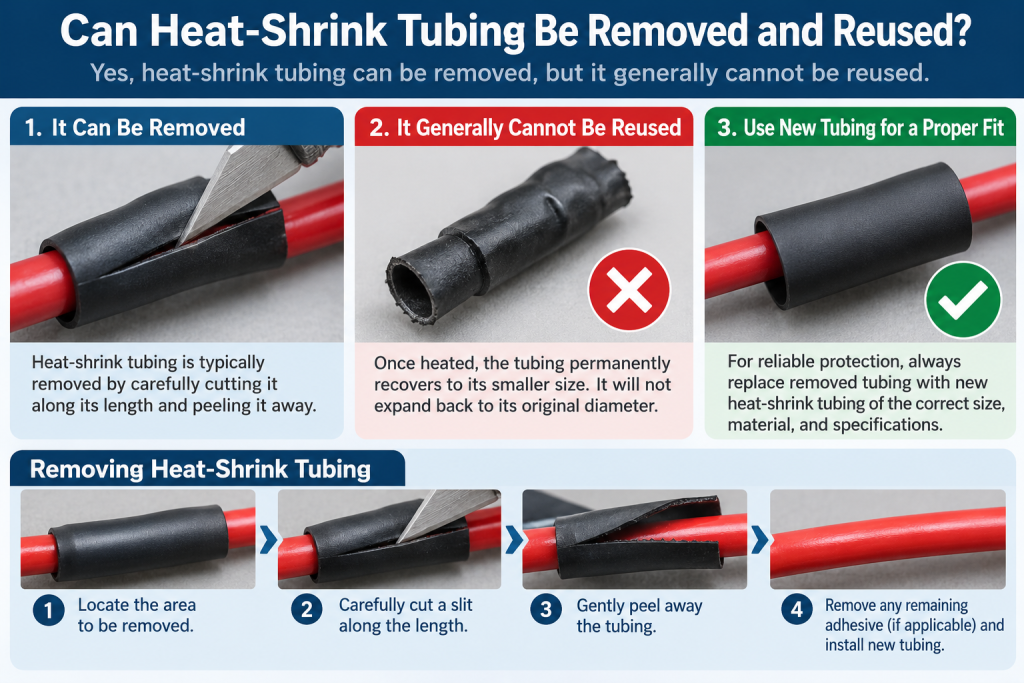
Yes. Heat-shrink tubing can be removed from a wire, cable, connector, or other component, although it must be done carefully.
Once heat-shrink tubing has been properly installed, it conforms closely to the shape of the material underneath it. It cannot simply be slid off in most applications.
Instead, the tubing typically needs to be carefully cut along its length and peeled away.
A small knife, precision cutting tool, or similar instrument may be used to create a slit in the tubing. Extra care is necessary when working around delicate wires, insulation, connectors, and other components. Cutting too deeply can damage the material the heat shrink was intended to protect.
For particularly delicate assemblies, removing heat-shrink tubing may require greater precision to avoid damaging the underlying component.
Can Heat-Shrink Tubing Be Reused?
In most cases, no.
Heat-shrink tubing is designed to undergo a permanent dimensional change when exposed to the appropriate amount of heat. During installation, the tubing recovers toward its manufactured or “recovered” dimensions and forms a tight fit around the object underneath.
After this process occurs, the tubing does not simply return to its original expanded diameter when removed.
This means a piece of heat-shrink tubing that has already been shrunk cannot normally be expanded again and installed on another component.
Even if a previously installed piece could be removed intact, attempting to reuse it could result in an improper fit and reduced protection.
For a reliable installation, previously used tubing should generally be replaced with new heat-shrink tubing of the appropriate size and material.
Why Doesn’t Heat-Shrink Tubing Return to Its Original Size?
Heat-shrink tubing is manufactured using polymers that are processed so they can recover toward a predetermined size when heated.
The tubing is initially formed and then expanded during manufacturing. When an installer applies sufficient heat, the material “remembers” its smaller dimensions and contracts.
This behavior is what makes heat-shrink tubing so useful. Instead of relying on mechanical fasteners to create a close fit, the tubing conforms to the wire, cable, splice, or component underneath it.
However, the recovery process is not intended to be repeatedly reversed. Once the tubing has recovered, reheating it will not restore its original expanded diameter.
What Happens If You Reheat Heat-Shrink Tubing?
Reheating already-shrunk tubing generally will not make it expand again.
Depending on the tubing material and the amount of heat applied, additional heating may cause the tubing to tighten slightly if it has not reached its maximum recovery. Excessive heat, however, can damage the tubing.
Overheating may result in problems such as:
- Splitting or cracking
- Discoloration
- Uneven shrinking
- Surface damage
- Deformation
- Damage to the underlying wire or component
Heat should therefore be applied according to the specifications of the particular heat-shrink product being used.
More heat does not necessarily produce a better installation.
What About Adhesive-Lined Heat-Shrink Tubing?
Removing adhesive-lined heat-shrink tubing can be more difficult.
Also known as dual-wall heat-shrink tubing, these products typically contain an internal adhesive layer. As the tubing is heated, the outer layer contracts while the adhesive softens and flows around the underlying component.
This can create a strong environmental seal and provide additional protection against moisture and contaminants.
That advantage also makes removal more complicated.
Even after the outer tubing is carefully cut away, adhesive may remain attached to the wire, cable, connector, or component. The remaining material may need to be carefully removed before new tubing is installed.
Adhesive-lined tubing should not be expected to be reusable after removal.
When Should Heat-Shrink Tubing Be Removed?
There are several situations where removing existing heat-shrink tubing may become necessary.
For example, a technician may need access to a connection beneath the tubing to diagnose an electrical problem. A wire or splice may need to be repaired, or a component may need to be replaced.
Removal may also be necessary when:
- A wiring configuration is being modified
- A connector needs to be replaced
- The original tubing was incorrectly sized
- Heat shrink was improperly installed
- The tubing has been physically damaged
- Additional inspection of a connection is required
- A cable or wire assembly is being refurbished
Once the necessary work has been completed, new tubing can be installed to restore protection.
Can You Put New Heat-Shrink Tubing Over Old Tubing?
Sometimes.
If the existing tubing is still structurally sound and the application permits it, a larger piece of heat-shrink tubing may be installed over the existing material.
However, simply adding another layer is not always the best solution.
If the original tubing is cracked, contaminated, improperly installed, or concealing a damaged electrical connection, the underlying problem should be addressed first.
The additional layer also increases the overall diameter of the assembly, which may create clearance issues in tightly packed equipment.
When environmental sealing is important, the condition of the underlying tubing and compatibility between materials should also be considered.
How to Replace Heat-Shrink Tubing
When existing heat-shrink tubing must be replaced, selecting the correct replacement is critical.
The new tubing needs to be large enough in its expanded state to fit over the largest portion of the component while still shrinking sufficiently to create a secure fit around the smallest portion.
This is where shrink ratio becomes important.
Common ratios include 2:1, 3:1, and higher shrink ratios for applications involving significant differences between component diameters.
For example, a 2:1 heat-shrink product is designed so its expanded diameter is approximately twice its fully recovered diameter.
Other factors should also be considered when selecting replacement tubing, including:
- Operating temperature
- Wall thickness
- Electrical insulation requirements
- Chemical exposure
- Moisture exposure
- Abrasion resistance
- UV exposure
- Flame-retardancy requirements
- Flexibility
- Shrink temperature
- Environmental sealing requirements
Choosing heat shrink based solely on diameter may result in a product that fits physically but does not provide the protection required by the application.
Can You Repair Damaged Heat-Shrink Tubing?
Minor surface damage does not always mean an entire cable assembly needs to be replaced, but damaged heat shrink should be evaluated carefully.
If the tubing has split, cracked, burned, or otherwise lost its ability to protect the underlying component, replacement is generally the safer option.
In some applications, another appropriately sized piece of tubing can be installed over the affected area. In others, the damaged tubing should be completely removed before new material is installed.
The appropriate approach depends on the application and the reason the heat shrink is being used.
A cosmetic covering, for example, may have very different requirements from heat-shrink tubing used for electrical insulation or environmental sealing.
Choosing the Right Replacement Heat-Shrink Tubing
Heat-shrink tubing is available in many materials, configurations, shrink ratios, wall thicknesses, and performance specifications.
Selecting the right product depends on the operating environment and the component being protected.
Industrial applications may require heat-shrink tubing capable of handling demanding conditions such as elevated temperatures, chemicals, moisture, abrasion, vibration, or electrical stress.
Specialized products can also provide features such as flame retardancy, environmental sealing, electrical insulation, identification, and electromagnetic interference protection.
Taking the time to select the appropriate tubing can improve both the durability and reliability of the finished assembly.
The Bottom Line: Replace Rather Than Reuse
So, can heat-shrink tubing be removed and reused?
Heat-shrink tubing can usually be removed by carefully cutting and peeling it away from the underlying component. However, once heat-shrink tubing has been shrunk, it generally should not be reused.
Its ability to recover toward a predetermined diameter is fundamental to how heat-shrink tubing works. Once that recovery has occurred, the tubing cannot simply be returned to its original expanded dimensions for another installation.
If heat shrink needs to be removed during maintenance, repair, or modification, replacing it with new, properly sized tubing is typically the best approach.
At Nu-Tech, we provide heat-shrink tubing and related solutions for a wide variety of industrial and electrical applications. Choosing the correct material, size, shrink ratio, and performance characteristics can make a significant difference in the reliability of the finished installation.
Whether you’re replacing existing heat shrink or selecting tubing for a new application, working with the right product from the beginning helps ensure dependable protection and long-term performance.