 Plastic injection molding is a popular manufacturing process for producing high volumes of durable, precise plastic components. It offers excellent repeatability, design flexibility, and relatively low production costs once manufacturing is underway. However, the total cost of an injection molding project can vary considerably depending on several factors.
Understanding what affects plastic injection molding costs can help businesses make better decisions when developing new products, selecting materials, designing molds, and planning production runs.
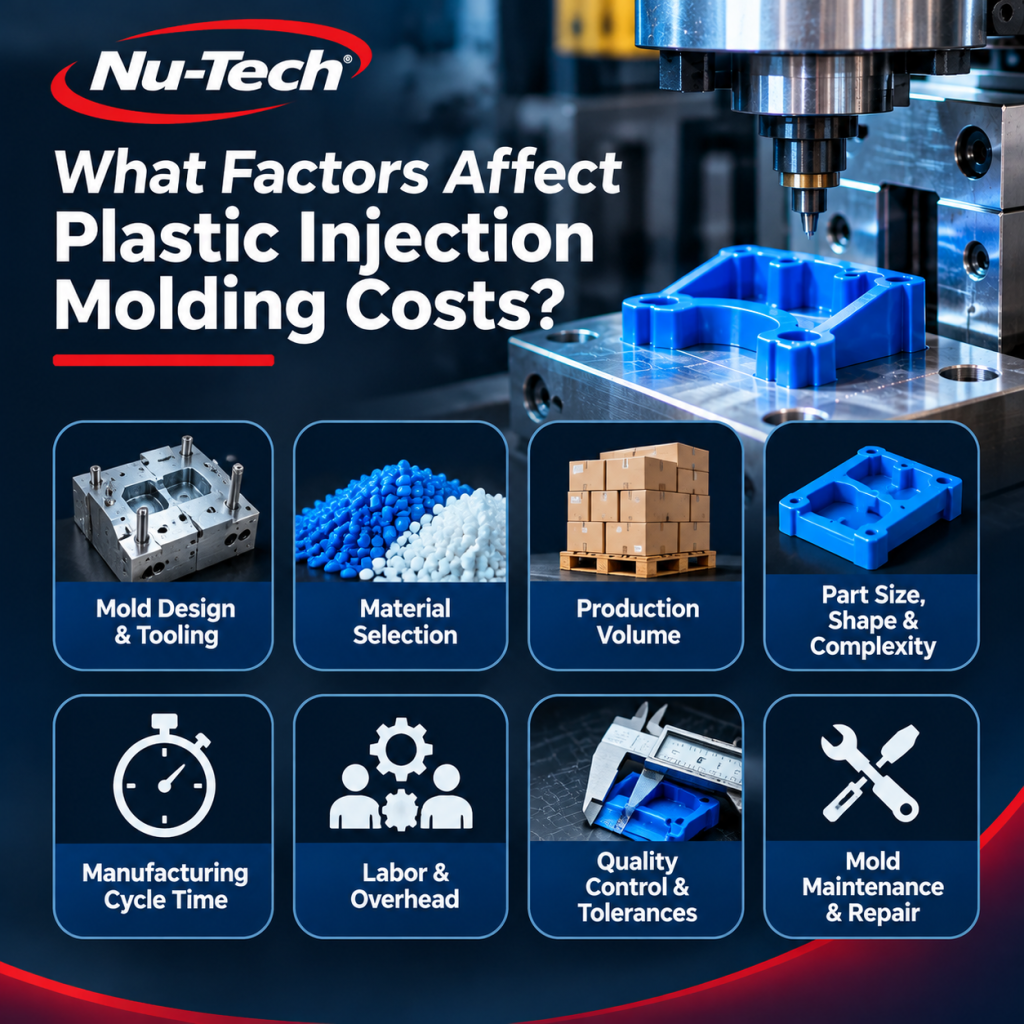
1. Injection Mold Design and Tooling Costs
One of the largest initial expenses in plastic injection molding is the design and manufacturing of the mold itself.
Injection molds must be engineered to withstand repeated cycles of high pressure and temperature while maintaining dimensional accuracy. The complexity of the mold has a direct impact on its manufacturing cost.
Several design considerations can influence tooling expenses:
- Mold complexity: Intricate geometries, undercuts, and specialized features require more advanced tooling.
- Cavity count: Single-cavity molds are generally less expensive to manufacture, while multi-cavity molds can produce more components per cycle.
- Mold material: Aluminum molds may be suitable for certain lower-volume applications, while hardened steel molds are often selected for high-volume production.
- Surface finish: Specialized textures, polishing, and cosmetic finishes can increase tooling costs.
Investing in an appropriately designed mold can help reduce long-term production expenses and improve manufacturing consistency.
2. Plastic Material Selection
The type of plastic resin used in injection molding also influences overall project costs.
Different materials have different purchase prices, processing requirements, and performance characteristics. For example, polypropylene and polyethylene are often economical choices, while specialized engineering plastics such as PEEK and certain high-performance nylons can be significantly more expensive.
Material selection should consider:
- Mechanical strength and impact resistance
- Operating temperature requirements
- Chemical and moisture resistance
- Flexibility and durability
- Appearance and surface finish
- Regulatory and industry requirements
Choosing the least expensive material is not always the most economical decision. A material that better suits the application may provide longer service life and reduce the likelihood of component failure.
3. Production Volume
Production quantity is one of the most important factors affecting the cost per injection molded part.
Although designing and manufacturing an injection mold can require a substantial initial investment, that expense is distributed across the total number of components produced.
For larger production runs, the initial tooling investment is spread across more units, generally reducing the cost per part.
Smaller production runs may have a higher unit cost because tooling, setup, and engineering expenses are distributed across fewer components.
Businesses should carefully evaluate anticipated production demand when deciding whether injection molding is the right manufacturing solution.
4. Part Size, Shape, and Complexity
The physical characteristics of a plastic component can significantly influence manufacturing expenses.
Larger components typically require more material, larger molds, and greater machine capacity. Complex designs may also require specialized tooling features, additional machining, or more demanding manufacturing processes.
Other important considerations include:
- Wall thickness and material distribution
- Required dimensional tolerances
- Draft angles and undercuts
- Internal features and detailed geometries
- Surface texture and cosmetic requirements
Designing components with injection molding in mind can help simplify tooling requirements and minimize unnecessary production costs.
5. Manufacturing Cycle Time
Cycle time refers to the total time required to complete one injection molding cycle. This generally includes mold closing, plastic injection, cooling, and part ejection.
Shorter cycle times allow manufacturers to produce more components within a given period, improving equipment utilization and production efficiency.
Cooling time is particularly important because plastic must solidify sufficiently before the finished component can be removed from the mold.
Factors that influence cycle time include material properties, part thickness, mold temperature, cooling system design, and machine settings.
Optimizing these variables can improve production efficiency without compromising component quality.
6. Labor and Manufacturing Overhead
The cost of operating an injection molding facility extends beyond plastic materials and tooling.
Labor, electricity, equipment maintenance, facility expenses, and quality control all contribute to the total manufacturing cost.
Automation can reduce certain labor requirements and improve production consistency, particularly during large manufacturing runs. However, automated systems may require additional upfront investment.
Equipment selection and production planning also influence overhead expenses. Using appropriately sized machinery and maintaining efficient production schedules can help control operating costs.
7. Quality Control and Tolerances
Quality requirements can have a considerable impact on plastic injection molding expenses.
Components requiring extremely tight dimensional tolerances, specialized surface finishes, or rigorous inspection procedures may require additional engineering and manufacturing controls.
Quality control measures can include dimensional inspections, material testing, visual examinations, and functional testing.
Although these requirements may increase initial production costs, they help reduce defects, minimize waste, and ensure that finished components meet their intended specifications.
8. Mold Maintenance and Repair
Injection molds experience repeated mechanical stress, heat, and pressure throughout their service life. Over time, these conditions can cause wear, corrosion, surface damage, and dimensional changes.
Regular maintenance is essential for keeping molds in good operating condition and preventing unexpected production interruptions.
Depending on the type and extent of damage, specialized repair techniques such as micro-TIG welding may be used to restore worn or damaged tooling surfaces.
Proper maintenance and timely repairs can extend mold service life, reduce replacement expenses, and help maintain consistent production quality.
How Can Businesses Reduce Plastic Injection Molding Costs?
Although some manufacturing expenses are unavoidable, several strategies can help businesses control their injection molding budgets.
Consider the following approaches:
- Optimize product design: Simplify unnecessary features and use consistent wall thicknesses where appropriate.
- Select suitable materials: Choose a resin that meets performance requirements without paying for unnecessary properties.
- Plan production volumes: Evaluate demand to determine whether larger production runs offer meaningful cost savings.
- Improve mold design: Invest in tooling that supports efficient material flow, cooling, and part ejection.
- Reduce cycle times: Optimize processing conditions and cooling systems to improve production efficiency.
- Maintain injection molds: Schedule regular inspections and address tooling damage before it becomes more expensive to repair.
Early collaboration between product designers, engineers, and injection molding specialists can help identify potential cost savings before production begins.
Conclusion
Plastic injection molding costs are influenced by numerous factors, including mold design, material selection, production volume, component complexity, cycle time, and quality requirements.
Understanding these considerations allows businesses to make more informed manufacturing decisions and identify opportunities to improve production efficiency.
At Nu-Tech, we recognize the importance of precision, reliable tooling, and effective manufacturing solutions. Explore Nu-Tech to learn more about our industrial capabilities and specialized services.