 Heat-shrink tubing is widely used across industrial and electrical applications to protect wires, cables, connectors, and other components. Most conventional heat-shrink tubing is designed to provide electrical insulation, helping prevent unwanted electrical contact while protecting components from environmental damage.
However, some specialized applications require a different approach.
Conductive heat-shrink tubing is engineered to provide electrical conductivity while retaining certain protective and installation benefits associated with heat-shrinkable materials.
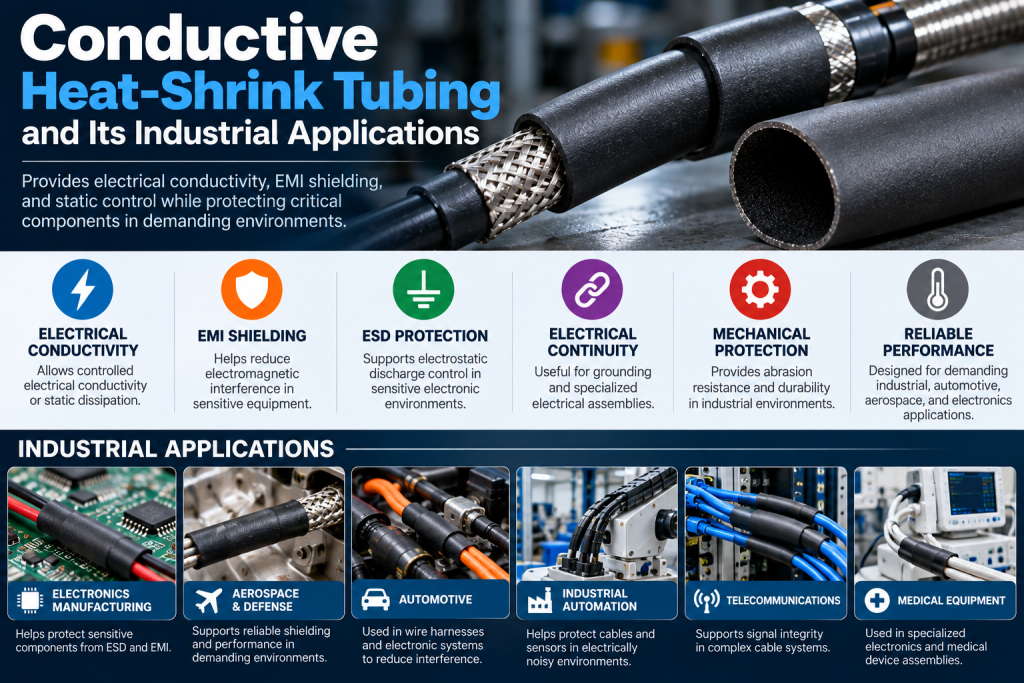
These specialized products can be useful in applications involving electromagnetic interference (EMI), electrostatic discharge (ESD), electrical grounding, and shielding of sensitive electronic assemblies.
Understanding how conductive heat-shrink tubing works, where it is used, and how it differs from conventional insulating tubing can help engineers and manufacturers select appropriate materials for demanding industrial environments.
What Is Conductive Heat-Shrink Tubing?
Conductive heat-shrink tubing is a specialized type of heat-shrinkable material designed to provide an electrically conductive or dissipative pathway.
Unlike conventional heat-shrink tubing, which is generally formulated to resist electrical current, conductive tubing incorporates materials or structures that allow electrical charges to move through or along the product.
Depending on the design, conductivity may be achieved through conductive fillers, specialized polymer compounds, metallic layers, or conductive textile structures.
When exposed to the appropriate installation temperature, the tubing contracts around the underlying component.
This allows the material to conform to the shape of cables, connectors, and other assemblies while providing its specified electrical properties.
Conductive heat-shrink products are not all interchangeable. Some are intended primarily for static dissipation, while others are designed to support electrical continuity or electromagnetic shielding.
How Does Conductive Heat-Shrink Tubing Work?
The operating principle depends on the material and construction of the tubing.
Traditional heat-shrink tubing is typically manufactured from polymer materials that have been processed to recover toward a smaller diameter when heated.
Conductive heat-shrink tubing uses a similar recovery mechanism but incorporates electrically conductive materials.
These materials may form pathways through which electrical charges can travel.
For example, a conductive polymer compound may contain carbon-based additives that create a network of conductive particles within the material.
Other products may use metallic components or conductive fabrics to achieve particular electrical characteristics.
Once installed, the tubing may help establish electrical continuity, dissipate static charge, or contribute to shielding, depending on its construction and the surrounding assembly.
Importantly, conductivity does not automatically mean effective EMI shielding or safe grounding. Those functions depend on the product’s electrical characteristics, installation method, and the complete system design.
Conductive vs. Standard Heat-Shrink Tubing
The primary difference between conductive and standard heat-shrink tubing is their intended electrical behavior.
Standard tubing is generally designed to provide insulation, while conductive tubing is designed to permit controlled electrical conduction or charge dissipation.
| Feature | Standard Heat-Shrink Tubing | Conductive Heat-Shrink Tubing |
|---|---|---|
| Electrical properties | Generally insulating | Conductive or dissipative |
| Primary function | Insulation and protection | Electrical continuity, static control, or specialized shielding |
| Materials | Conventional insulating polymers | Conductive compounds or specialized structures |
| EMI shielding | Generally limited without additional shielding materials | Possible with appropriately designed products |
| Static dissipation | Typically not a primary function | Available in suitable formulations |
| Applications | General electrical and cable protection | Specialized electronics and industrial assemblies |
| Selection criteria | Insulation, temperature, shrink ratio, and environmental resistance | Electrical resistance, conductivity, shielding performance, and environmental requirements |
Choosing between these products requires a clear understanding of the application’s electrical requirements.
A conductive product should never be substituted for insulating heat-shrink tubing where electrical isolation is necessary.
What Are the Main Benefits of Conductive Heat-Shrink Tubing?
Conductive heat-shrink tubing can offer several advantages in specialized industrial applications.
1. Electrostatic Discharge Protection
Electrostatic discharge occurs when accumulated electrical charge moves between objects with different electrical potentials.
In environments involving sensitive electronic components, uncontrolled static discharge can cause equipment damage or manufacturing defects.
Certain conductive or static-dissipative heat-shrink products can help manage accumulated charge when incorporated into an appropriately designed ESD control system.
These materials may be useful in electronics manufacturing, component handling, and specialized equipment assemblies.
However, the electrical resistance of the tubing must be suitable for the intended ESD application.
2. Electromagnetic Interference Shielding
Electromagnetic interference can disrupt the operation of sensitive electronic equipment.
Sources of EMI may include electric motors, switching power supplies, radio-frequency equipment, and other electrical systems.
Certain conductive heat-shrink products are designed to contribute to electromagnetic shielding by incorporating conductive materials or specialized shielding structures.
When properly integrated into a cable assembly, these products may help reduce unwanted electromagnetic coupling.
Shielding effectiveness depends on factors such as material conductivity, frequency, coverage, and termination design.
3. Electrical Continuity
Some conductive heat-shrink products may be used where maintaining electrical continuity between compatible conductive surfaces is necessary.
This can be useful in specialized cable assemblies, connector systems, and equipment designs.
However, electrical continuity must be verified through appropriate testing.
A conductive sleeve alone should not be assumed to provide a reliable protective grounding connection.
4. Mechanical Protection
Depending on the product, conductive heat-shrink tubing may provide mechanical protection similar to other heat-shrink materials.
This can include protection against abrasion, handling damage, and certain environmental conditions.
The degree of protection depends on the tubing’s construction, wall thickness, and material properties.
5. Compact Installation
Heat-shrinkable materials can conform closely to components, making them useful in assemblies where space is limited.
For specialized electronic equipment, a conductive heat-shrink product may provide a compact alternative to certain bulkier protective or shielding arrangements.
Its suitability depends on the electrical and mechanical requirements of the application.
Industrial Applications of Conductive Heat-Shrink Tubing
Conductive heat-shrink tubing can be used in several industries where electrical performance and component protection are important.
Electronics Manufacturing
Electronics manufacturing environments frequently involve components that are sensitive to electrostatic discharge.
Static charge can accumulate during handling, assembly, packaging, and equipment operation.
Appropriately selected conductive or static-dissipative tubing may be incorporated into equipment assemblies to help manage electrical charge.
Potential applications include specialized cable coverings, equipment components, and ESD-sensitive manufacturing systems.
The tubing must be compatible with the facility’s broader ESD control procedures.
Aerospace and Defense
Aerospace and defense equipment often contains complex electrical systems operating in demanding environments.
Electromagnetic compatibility and reliable cable protection can be important considerations in these applications.
Specialized conductive heat-shrink products may be used in cable assemblies and electronic systems requiring particular shielding or electrical performance characteristics.
However, products used in aerospace and defense applications must satisfy the relevant material, environmental, and qualification requirements.
Telecommunications
Telecommunications systems rely on the reliable transmission of electrical and electronic signals.
In certain installations, electromagnetic interference can affect signal integrity.
Conductive heat-shrink products designed for shielding applications may be incorporated into cable assemblies or connector systems to support electromagnetic compatibility.
Proper shielding termination and electrical continuity are important for achieving the intended performance.
Automotive Manufacturing
Modern vehicles contain increasingly sophisticated electronic systems, including sensors, control modules, communication networks, and electrical power systems.
These systems may operate near motors, power electronics, and other potential sources of electromagnetic interference.
Specialized conductive heat-shrink products may support shielding or static-control requirements in certain automotive assemblies.
Material selection must also account for temperature fluctuations, vibration, fluids, and other automotive operating conditions.
Industrial Automation
Automated manufacturing equipment frequently incorporates sensors, controllers, motors, and communication systems.
These components may operate in electrically noisy environments.
Appropriately designed conductive shielding products can help protect sensitive connections from electromagnetic interference.
Potential applications include specialized control cables, sensor connections, and industrial communication assemblies.
Medical Equipment
Medical electronic equipment may contain sensitive circuits and signal-processing systems.
Electromagnetic compatibility is an important consideration in the design of many medical devices.
Specialized conductive heat-shrink products may be evaluated for certain shielding or electrical applications.
However, medical equipment manufacturers must verify that selected materials meet all applicable electrical safety, performance, cleanliness, and regulatory requirements.
Conductive Heat-Shrink Tubing for EMI Shielding
One of the most important potential applications for conductive heat-shrink tubing is electromagnetic interference shielding.
EMI shielding works by reducing the coupling of unwanted electromagnetic energy into or out of a system.
Conductive materials can contribute to this process by reflecting, absorbing, or redirecting electromagnetic energy.
However, the effectiveness of a shielding solution depends on more than simply using a conductive material.
Important considerations include:
- Material conductivity
- Shielding coverage
- Frequency range
- Electrical continuity
- Connector termination
- Shielding layer thickness
- Installation quality
- Environmental durability
For example, a conductive sleeve that does not establish an appropriate connection to the surrounding shielding system may provide limited protection.
Engineers should therefore evaluate shielding effectiveness at the assembly level rather than relying solely on the presence of conductive material.
Conductive vs. Static-Dissipative Heat-Shrink Tubing
Although the terms are sometimes used together, conductive and static-dissipative materials are not necessarily the same.
Conductive materials generally allow electrical charge to move relatively easily.
Static-dissipative materials are designed to permit charge to dissipate in a more controlled manner.
The distinction is important because different applications require different electrical resistance characteristics.
For example, an ESD-sensitive manufacturing environment may require materials that dissipate accumulated charge without creating an excessively conductive path.
By contrast, a shielding application may require low-resistance electrical continuity.
Engineers should review surface resistance, volume resistivity, and other relevant specifications before selecting a product.
What Materials Are Used in Conductive Heat-Shrink Tubing?
The construction of conductive heat-shrink tubing varies depending on its intended function.
Carbon-Filled Polymers
Certain conductive polymer products incorporate carbon-based additives.
These additives can create conductive pathways within the material.
The resulting electrical properties depend on the polymer, additive concentration, and manufacturing process.
Metallic or Metallized Structures
Some specialized shielding products incorporate metallic layers or metallized components.
These structures may provide conductivity suitable for certain electromagnetic shielding applications.
Their performance depends on construction, coverage, and electrical connections.
Conductive Textile Materials
Conductive fabric or cloth-based heat-shrink products may combine flexible textile structures with electrically conductive materials.
These products can be useful in specialized shielding applications where flexibility and conformability are important.
Different constructions offer different combinations of electrical performance, flexibility, and environmental resistance.
How to Choose Conductive Heat-Shrink Tubing
Selecting the appropriate conductive heat-shrink tubing requires evaluating both electrical and mechanical requirements.
Electrical Resistance
Determine whether the application requires high conductivity, controlled static dissipation, or a particular resistance range.
Electrical specifications should be evaluated using appropriate test methods.
Shielding Performance
If EMI protection is required, review the product’s shielding effectiveness and relevant frequency characteristics.
Not every conductive product is suitable for EMI shielding.
Shrink Ratio
Shrink ratio determines how much the tubing can contract during installation.
The tubing must fit over the largest portion of the component while recovering sufficiently around the intended surface.
Operating Temperature
The tubing must tolerate the temperatures encountered during normal operation.
Installation temperature and continuous operating temperature are different specifications and should not be confused.
Mechanical Durability
Consider whether the tubing will experience abrasion, vibration, repeated movement, or physical contact with surrounding equipment.
Environmental Resistance
Applications involving moisture, chemicals, oils, or UV exposure may require specialized materials.
Compatibility With the Assembly
Conductive tubing must be evaluated in the context of the complete electrical system.
Unintended contact with energized conductors or incompatible materials can create electrical safety or reliability problems.
Is Conductive Heat-Shrink Tubing Safe for Electrical Insulation?
Conductive heat-shrink tubing should not be treated as a substitute for conventional electrical insulation.
Because conductive products are designed to permit electrical charge movement, they may create unwanted electrical pathways if used incorrectly.
For example, installing conductive tubing directly over an exposed energized conductor could create a shock or short-circuit hazard.
Where electrical insulation is required, an appropriately rated insulating material must be used.
Conductive tubing may be installed over an existing insulated assembly in certain specialized designs, but the complete arrangement must be evaluated for electrical safety.
Always verify the electrical properties and intended use of a conductive heat-shrink product before installation.
What Is the Difference Between Conductive and EMI-Shielded Heat-Shrink Tubing?
Conductive heat-shrink tubing and EMI-shielded heat-shrink tubing are closely related concepts, but they are not necessarily interchangeable.
Conductive tubing is defined primarily by its ability to conduct or dissipate electrical charge.
EMI-shielded tubing is designed specifically to reduce electromagnetic interference.
A conductive material may contribute to shielding, but conductivity alone does not establish effective EMI protection.
Products intended for EMI shielding may incorporate specialized conductive structures, materials, or construction methods to achieve the required performance.
When electromagnetic compatibility is the primary objective, engineers should select products with suitable shielding specifications rather than relying only on general conductivity claims.
Finding the Right Conductive Heat-Shrink Tubing Supplier
Conductive heat-shrink tubing is a specialized product category, and selecting the correct material can require careful evaluation.
Engineers and purchasing professionals should work with suppliers who can provide relevant product specifications and guidance on available materials.
Important questions to ask include:
- What electrical resistance characteristics does the product provide?
- Is the tubing conductive or static-dissipative?
- Has the product been evaluated for EMI shielding?
- What shrink ratios and dimensions are available?
- What temperatures can the material withstand?
- Are there specific installation requirements?
- Does the product meet the application’s relevant industry standards?
At Nu-Tech, we provide heat-shrink tubing solutions for a wide range of industrial and electrical applications, including specialized products for demanding performance requirements.
Our product offerings include options designed for applications where conventional heat-shrink tubing may not provide all the necessary characteristics.
Selecting the appropriate material and verifying its specifications are essential steps toward reliable electrical and mechanical performance.
Final Thoughts: Conductive Heat-Shrink Tubing and Its Industrial Applications
Conductive heat-shrink tubing offers specialized capabilities beyond those of conventional insulating heat-shrink products.
Depending on its construction, it may support electrostatic discharge control, electrical continuity, electromagnetic shielding, and mechanical protection in demanding industrial environments.
Potential applications include electronics manufacturing, telecommunications, automotive systems, aerospace equipment, industrial automation, and specialized electronic assemblies.
However, conductive heat-shrink tubing must be selected carefully.
Not every conductive product provides effective EMI shielding, and conductive tubing should never be assumed to provide electrical insulation.
Understanding the material’s electrical properties, environmental limitations, and intended function is essential for selecting the right solution.
For manufacturers and engineers seeking specialized heat-shrink tubing, choosing products with the appropriate specifications can help support reliable performance and long-term equipment protection.
Explore industrial heat-shrink tubing solutions at Nu-Tech.
Conductive Heat-Shrink Tubing and Its Industrial Applications