 Heat-shrink tubing is widely used in electrical, industrial, and manufacturing applications to protect wires, cables, connectors, and other components. Once heated, the tubing contracts around the underlying material, providing insulation, mechanical protection, and, in certain products, environmental sealing.
But what happens when a wire needs to be repaired or a connection needs to be modified? Can heat-shrink tubing be removed and reused?
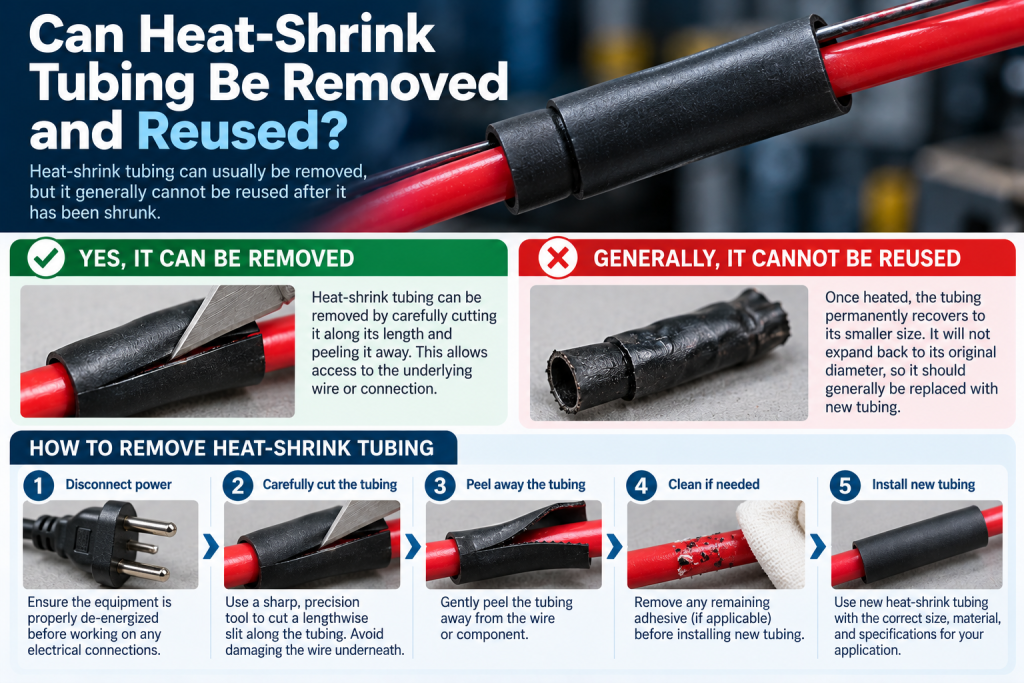
The short answer is that heat-shrink tubing can usually be removed, but it generally cannot be reused after shrinking. Once the material has contracted, it cannot simply return to its original expanded diameter.
Understanding how to remove heat-shrink tubing, why reuse is generally impractical, and how to select a suitable replacement can help prevent damage and maintain the reliability of electrical assemblies.
Can Heat-Shrink Tubing Be Removed?
Yes, heat-shrink tubing can be removed from wires, cables, and other components. However, removal typically requires cutting the tubing rather than sliding it off.
Heat-shrink tubing is designed to fit tightly around the underlying component after heat is applied. This close fit makes it effective for insulation and protection but also makes removal more difficult.
The most common removal method involves carefully cutting the tubing lengthwise and peeling it away.
When removing heat-shrink tubing, technicians should take precautions to avoid damaging the insulation or components underneath.
For delicate electrical assemblies, specialized cutting tools or precision techniques may be necessary.
How to Remove Heat-Shrink Tubing Safely
Removing heat-shrink tubing requires patience and attention to detail, particularly when working with small wires or sensitive components.
Step 1: Disconnect the Power
Before working on an electrical connection, ensure the equipment is properly de-energized and follow applicable electrical safety procedures.
Never attempt to cut heat-shrink tubing from energized wiring.
Step 2: Inspect the Tubing
Examine the tubing to determine its thickness, material, and whether it contains an adhesive lining.
Single-wall tubing is generally easier to remove than adhesive-lined tubing, which may bond to the underlying surface.
Step 3: Carefully Cut Along the Tubing
Using an appropriate precision cutting tool, carefully create a lengthwise slit in the tubing.
Avoid cutting deeply enough to damage the wire insulation or component underneath.
For particularly delicate assemblies, professional removal may be preferable.
Step 4: Peel Away the Tubing
Once the tubing has been slit, gently separate it from the underlying component.
If the tubing is adhesive-lined, additional care may be required to remove the bonded material.
Step 5: Inspect the Underlying Component
After removal, examine the wire, cable, or connector for signs of damage.
Any damaged insulation or components should be repaired or replaced according to the application’s requirements before new tubing is installed.
Can Heat-Shrink Tubing Be Reused?
In most applications, heat-shrink tubing should not be reused after it has been installed and shrunk.
Heat-shrink tubing is manufactured to recover toward a predetermined smaller diameter when exposed to heat.
During installation, the material contracts around the underlying component and creates a secure fit.
Once this recovery process occurs, the tubing cannot simply be expanded back to its original manufactured dimensions using ordinary installation methods.
Even if a section of tubing can be removed without visible damage, it may no longer provide the correct dimensions or protective performance for another installation.
For reliable results, replacing removed tubing with new material is generally recommended.
Why Can’t Heat-Shrink Tubing Be Reused?
The reason heat-shrink tubing cannot normally be reused comes down to how the material is manufactured.
Many heat-shrink products are made from polymers that undergo specialized processing to establish their heat-recovery characteristics.
During manufacturing, the tubing is expanded from its smaller dimensions.
When heat is applied during installation, the tubing recovers toward its original, smaller diameter.
This recovery allows the tubing to conform closely to wires, connectors, and other components.
However, the process is not designed to be repeatedly reversed.
Once the tubing has recovered, reheating it will not restore its expanded diameter.
Attempting to stretch or force previously shrunk tubing onto another component may damage the material and compromise its protective properties.
What Happens If You Reheat Heat-Shrink Tubing?
Reheating previously installed heat-shrink tubing does not normally cause it to expand.
If the tubing has not fully recovered during its initial installation, additional controlled heating may cause further shrinkage.
However, excessive heating can damage the material.
Potential consequences include:
- Cracking or splitting
- Discoloration
- Loss of flexibility
- Surface deformation
- Reduced mechanical protection
- Damage to underlying insulation or components
Different heat-shrink materials have different installation temperatures and operating limits.
Always follow the manufacturer’s specifications when applying heat.
Is Adhesive-Lined Heat-Shrink Tubing Reusable?
Adhesive-lined heat-shrink tubing is particularly difficult to reuse.
Also known as dual-wall heat-shrink tubing, this product typically features an outer heat-shrinkable layer and an internal adhesive lining.
During installation, heat causes the outer tubing to contract while the adhesive softens and flows around the underlying component.
This can create an environmental seal that helps protect against moisture and contaminants.
However, the adhesive may bond to the component, making removal more complicated.
Once the tubing has been removed, the adhesive layer may no longer provide the consistent coverage necessary for reliable sealing.
For this reason, adhesive-lined heat-shrink tubing should be replaced rather than reused.
Can You Remove Heat-Shrink Tubing Without Cutting It?
In certain situations, it may be possible to slide heat-shrink tubing off a component without cutting it.
For example, if the tubing was improperly sized or did not shrink sufficiently, it may remain loose enough to remove.
However, properly installed heat-shrink tubing is generally designed to fit tightly around the component.
Trying to pull it off may damage the tubing, the underlying insulation, or nearby connectors.
Heating the tubing again will not normally make it expand for easier removal.
For most installations, careful cutting is the more practical removal method.
Can You Install New Heat-Shrink Tubing Over Old Tubing?
In some applications, new heat-shrink tubing can be installed over an existing layer.
This may be useful when additional abrasion protection or insulation is required, provided the arrangement meets the application’s specifications.
However, installing new tubing over damaged tubing is not always advisable.
If the original tubing has cracked, deteriorated, or lost its protective properties, covering it with another layer may conceal an underlying problem.
Additional layers can also increase the diameter of the assembly and affect flexibility.
Before installing new tubing over existing material, consider the condition of the original tubing, the available space, and the electrical and environmental requirements.
When Should Heat-Shrink Tubing Be Replaced?
Heat-shrink tubing may need to be replaced for several reasons.
Common situations include:
- Electrical repairs: Accessing wiring or connections underneath the tubing.
- Damaged insulation: Replacing tubing that has cracked, split, or deteriorated.
- Equipment modifications: Changing wiring configurations or replacing connectors.
- Improper installation: Correcting tubing that was incorrectly sized or overheated.
- Environmental damage: Replacing tubing affected by chemicals, UV exposure, or excessive temperatures.
- Maintenance and inspection: Removing protective coverings to inspect or service components.
Replacing compromised tubing helps maintain the intended protection of the assembly.
How to Choose Replacement Heat-Shrink Tubing
When replacing heat-shrink tubing, selecting the correct product is essential.
Not all heat-shrink tubing offers the same performance characteristics.
Several factors should be considered.
Shrink Ratio
Shrink ratio describes the relationship between the tubing’s expanded diameter and its fully recovered diameter.
Common ratios include 2:1, 3:1, and 4:1.
The tubing must be large enough to fit over the component before shrinking while still recovering sufficiently to create a secure fit.
Material
Different materials provide different levels of resistance to heat, chemicals, abrasion, and environmental conditions.
Polyolefin is commonly used for general electrical applications, while specialized fluoropolymer products may be appropriate for more demanding environments.
Operating Temperature
Replacement tubing should be rated for the temperatures it will encounter during normal operation.
Using tubing outside its specified temperature range may lead to premature deterioration.
Environmental Protection
Applications exposed to moisture, chemicals, sunlight, or mechanical stress may require specialized tubing.
For example, adhesive-lined tubing may be appropriate where environmental sealing is necessary.
Wall Thickness
Wall thickness affects mechanical protection, flexibility, and the overall dimensions of the finished assembly.
Thin-wall tubing may be suitable for compact electrical applications, while thicker-wall products may provide additional protection in demanding environments.
How Long Does Heat-Shrink Tubing Last?
Properly selected and installed heat-shrink tubing can remain effective for many years.
Its lifespan depends on the material, operating environment, installation quality, and exposure to heat, chemicals, moisture, UV radiation, and mechanical stress.
Some products may provide decades of service under suitable conditions, although no universal lifespan applies to every heat-shrink material.
Regular inspection can help identify cracking, brittleness, abrasion, and other signs of deterioration.
Choosing the correct tubing from the beginning can also reduce the need for premature replacement.
Is Heat-Shrink Tubing Better Than Electrical Tape?
Heat-shrink tubing and electrical tape are both used to protect electrical connections, but they have different characteristics.
Heat-shrink tubing forms a close-fitting covering around the underlying component, while electrical tape relies on overlapping layers and adhesive.
For many permanent installations, heat-shrink tubing can offer advantages in durability, abrasion resistance, and appearance.
Electrical tape, however, may be more convenient for certain maintenance applications because it can be removed without cutting a rigid protective sleeve.
The appropriate choice depends on the application’s electrical, mechanical, and environmental requirements.
Neither should be substituted for the other without confirming that it meets the necessary specifications.
Choosing Reliable Heat-Shrink Tubing for Industrial Applications
Heat-shrink tubing plays an important role in protecting electrical components across a wide range of industries.
From cable assemblies and manufacturing equipment to telecommunications and specialized industrial systems, choosing the correct tubing helps support reliable long-term performance.
At Nu-Tech, we provide heat-shrink tubing solutions for industrial and electrical applications.
Selecting the appropriate material, shrink ratio, wall thickness, and performance characteristics can help ensure that replacement tubing provides the protection required by the application.
Whether you’re replacing damaged tubing or specifying products for a new project, choosing the right solution from the beginning can help reduce maintenance requirements and improve equipment reliability.
Final Thoughts: Can Heat-Shrink Tubing Be Removed and Reused?
Heat-shrink tubing can generally be removed, but it should not normally be reused after shrinking.
The material is designed to recover toward a smaller diameter when heated, creating a secure fit around the underlying component. Once this process occurs, the tubing cannot simply be restored to its original expanded size.
Although removal is often possible through careful cutting, replacing the tubing is typically the most reliable option.
For industrial and electrical applications, using new, properly specified heat-shrink tubing helps maintain insulation, mechanical protection, and environmental resistance.
Explore heat-shrink tubing solutions at Nu-Tech to find products suited to your application.