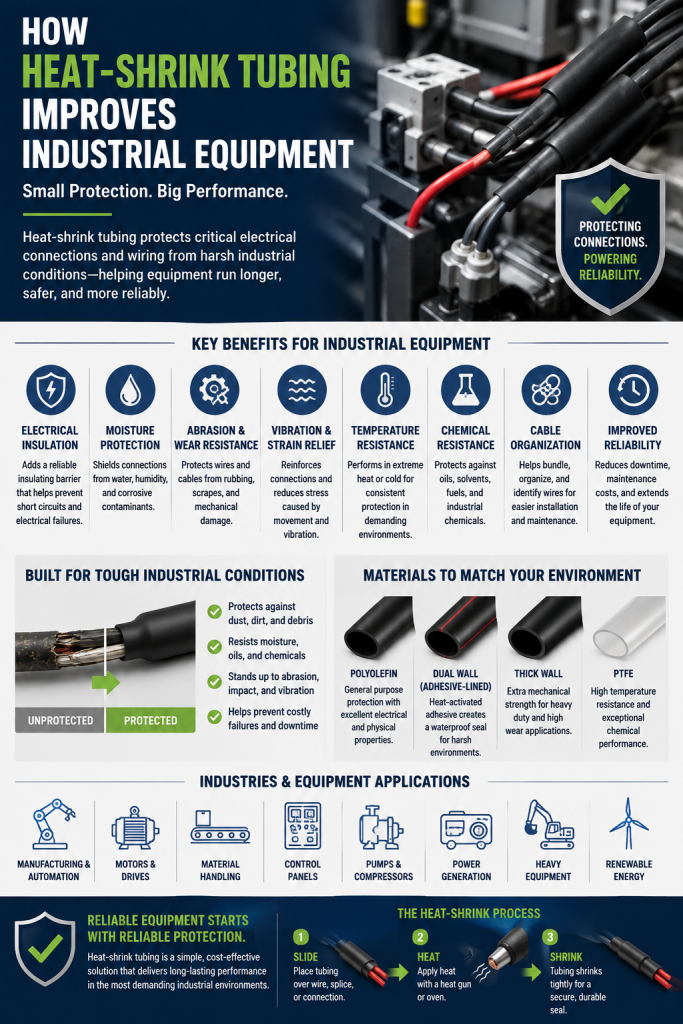
 Industrial equipment is expected to perform reliably under conditions that can be extremely demanding. Machinery may be exposed to heat, moisture, chemicals, vibration, abrasion, dust, and continuous movement—all while being expected to operate for long periods with minimal downtime.
Protecting the electrical systems inside this equipment is therefore an important part of maintaining performance and reliability.
Heat-shrink tubing provides a simple and effective way to protect wires, cables, terminals, connectors, and other electrical components. When properly selected and installed, heat-shrink tubing can help industrial equipment withstand harsh operating conditions, reduce maintenance requirements, and achieve a longer service life.
What Is Heat-Shrink Tubing?
Heat-shrink tubing is a polymer-based protective sleeve designed to shrink when heat is applied. The tubing is initially placed over a wire, cable, connection, or other component. Once heated to the appropriate temperature, it contracts around the component to create a close-fitting protective layer.
Depending on the material and construction, heat-shrink tubing can provide:
- Electrical insulation
- Abrasion resistance
- Moisture protection
- Chemical resistance
- Strain relief
- Mechanical reinforcement
- Environmental sealing
- Cable organization
These characteristics make heat-shrink tubing particularly useful in industrial environments where electrical components can experience considerably more stress than they would in ordinary applications.
Protecting Wiring in Harsh Industrial Environments
Industrial machinery rarely operates under ideal conditions. Manufacturing facilities, processing plants, warehouses, transportation systems, and other industrial environments can expose electrical components to contaminants and physical stresses.
Heat-shrink tubing creates an additional protective barrier around vulnerable wiring and connections.
Depending on the tubing selected, it can help protect components against exposure to:
- Dust and debris
- Moisture and humidity
- Oils and fluids
- Chemicals
- Temperature extremes
- Abrasion
- Vibration
Protecting these components can reduce the likelihood that environmental exposure will eventually contribute to an electrical or mechanical failure.
Reducing Abrasion and Mechanical Damage
Wires and cables inside industrial equipment can experience constant movement. Even cables that appear stationary may be subjected to vibration whenever machinery is operating.
Over thousands of operating hours, repeated contact between a wire and a nearby surface can gradually wear through its insulation.
Heat-shrink tubing adds another protective layer around vulnerable areas. This can be particularly valuable where wires pass near metal surfaces, enter equipment housings, or encounter repeated mechanical movement.
Preventing this type of gradual damage can help extend the service life of wiring assemblies and reduce unexpected failures.
Providing Additional Electrical Insulation
Damaged electrical insulation can cause equipment malfunctions, short circuits, and potentially serious safety concerns.
Heat-shrink tubing can provide an additional insulating barrier around electrical components such as:
- Wire splices
- Soldered connections
- Terminals
- Cable joints
- Connectors
- Individual conductors
Once installed, the tubing conforms closely to the protected area and helps isolate conductive components.
The electrical properties of heat-shrink products vary considerably, so manufacturers should always select tubing that meets the electrical requirements of the particular application.
Helping Protect Against Moisture
Moisture can be particularly damaging to electrical equipment. Water and persistent humidity can contribute to corrosion and deterioration of electrical connections.
For applications requiring additional environmental protection, adhesive-lined heat-shrink tubing can be especially useful.
As this type of tubing is heated, an internal adhesive layer flows around the component while the outer tubing contracts. This can create a more complete environmental seal than standard tubing alone.
Adhesive-lined tubing may be beneficial for industrial equipment exposed to washdowns, outdoor conditions, humidity, condensation, or other sources of moisture.
Improving Strain Relief
Connections are often among the weakest points in an electrical assembly.
When a cable is repeatedly bent, pulled, or moved near a connector, stress can become concentrated at the termination point. Eventually, conductors may loosen or break.
Heat-shrink tubing can provide additional mechanical support around these vulnerable areas. By reinforcing the transition between a cable and its connection point, properly selected tubing can help distribute stress across a larger area.
This makes heat-shrink tubing useful around connectors, terminals, cable exits, and other locations subjected to repeated movement.
Protecting Equipment From Vibration
Vibration is unavoidable in many industrial applications.
Motors, pumps, compressors, generators, conveyors, manufacturing machines, and heavy equipment can generate continuous vibration during normal operation. Over time, this movement can place significant stress on wiring and connections.
Heat-shrink tubing can reinforce these areas and help limit movement at sensitive connection points.
While heat-shrink tubing cannot eliminate vibration itself, it can become part of a broader cable-protection strategy designed to improve equipment durability.
Improving Cable Organization
Industrial equipment can contain extensive electrical wiring. Keeping those wires properly organized makes equipment easier to manufacture, inspect, troubleshoot, and maintain.
Heat-shrink products can be used to bundle or identify wires and cables within an assembly.
Color-coded or printable heat-shrink tubing can also help technicians identify particular:
- Circuits
- Cables
- Connections
- Components
- Electrical systems
Better cable organization can simplify maintenance and reduce the possibility of mistakes during servicing.
Supporting Equipment Reliability
An industrial machine can contain thousands of individual components, yet failure of a relatively small electrical connection may be enough to stop the entire system.
For manufacturers and facility operators, unplanned downtime can be expensive.
Production may stop while technicians locate the problem, obtain replacement components, perform repairs, and test the equipment before returning it to service.
Heat-shrink tubing helps address some common sources of electrical failure before they become larger problems.
Protecting vulnerable wires and connections can contribute to:
- Longer component life
- More dependable electrical systems
- Reduced maintenance requirements
- Fewer unexpected repairs
- Improved equipment availability
Although heat-shrink tubing represents a relatively small part of an industrial system, its protective role can have a significant effect on long-term reliability.
Heat-Shrink Tubing for Industrial Equipment Manufacturing
Heat-shrink tubing is valuable not only when repairing existing equipment but also during the manufacturing process.
Engineers can incorporate heat-shrink products directly into equipment designs to protect critical electrical systems from the beginning.
Potential applications include:
- Factory automation equipment
- Robotics
- Control systems
- Pumps and motors
- Material-handling equipment
- Power-generation equipment
- Processing machinery
- Heavy equipment
- Electrical cabinets
- Sensors and instrumentation
Considering heat-shrink requirements during the design stage allows engineers to account for dimensions, shrink ratios, materials, temperature requirements, and environmental conditions before production begins.
Choosing Heat-Shrink Tubing for Industrial Applications
There is no single heat-shrink product suitable for every piece of industrial equipment.
The appropriate solution depends on the operating environment and the component being protected.
Important factors include:
Shrink Ratio
Shrink ratio describes how much the tubing can decrease in diameter. The tubing must be large enough to fit over the component before shrinking while still becoming tight enough after heating.
Operating Temperature
Industrial equipment can experience significant temperature variations. The tubing material should be suitable for both the installation temperature and expected operating environment.
Material
Different heat-shrink materials provide different characteristics regarding flexibility, temperature resistance, chemical resistance, flame performance, and mechanical durability.
Wall Thickness
Wall thickness can influence flexibility, insulation, and mechanical protection. Applications exposed to substantial physical stress may require different tubing than protected internal wiring.
Environmental Exposure
Engineers should consider whether the tubing will encounter moisture, oils, chemicals, UV exposure, abrasion, or other environmental factors.
Adhesive Lining
Where additional sealing is required, adhesive-lined heat-shrink tubing may provide greater protection against environmental exposure.
Selecting tubing according to actual operating conditions is essential for achieving the intended performance.
Reducing Maintenance and Downtime
Preventive protection is generally preferable to repairing a failed electrical system after production has already stopped.
Heat-shrink tubing can help maintenance teams reinforce vulnerable electrical components during equipment installation, upgrades, and repairs.
For example, technicians may identify wiring that experiences excessive vibration or abrasion during routine inspections. Adding an appropriate protective solution can help address the problem before the underlying conductor becomes damaged.
Over the lifetime of industrial machinery, relatively small preventive measures can contribute to significant improvements in reliability and maintenance efficiency.
Extending the Service Life of Industrial Equipment
Industrial machinery represents a substantial investment, and manufacturers naturally want equipment to remain productive for as long as practical.
Protecting electrical infrastructure is an important part of accomplishing that goal.
Heat-shrink tubing helps preserve wiring, connections, and cable assemblies that might otherwise deteriorate more quickly under industrial operating conditions.
Longer-lasting electrical components can support the overall service life of the equipment while helping companies receive greater value from their machinery investments.
A Small Component With an Important Job
Heat-shrink tubing may represent only a tiny portion of an industrial machine, but protecting critical electrical components can have consequences for the entire system.
By providing insulation, mechanical reinforcement, strain relief, and protection against environmental conditions, heat-shrink tubing helps manufacturers build equipment capable of operating reliably in demanding environments.
For industrial equipment designers, manufacturers, and maintenance professionals, selecting the appropriate heat-shrink solution can help reduce failures, simplify maintenance, and protect valuable machinery.
As industrial systems become increasingly sophisticated and dependent on electronics, sensors, automation, and interconnected components, reliable cable protection will continue to be an important part of equipment design.
The right heat-shrink tubing helps protect the connections that keep industrial equipment running.