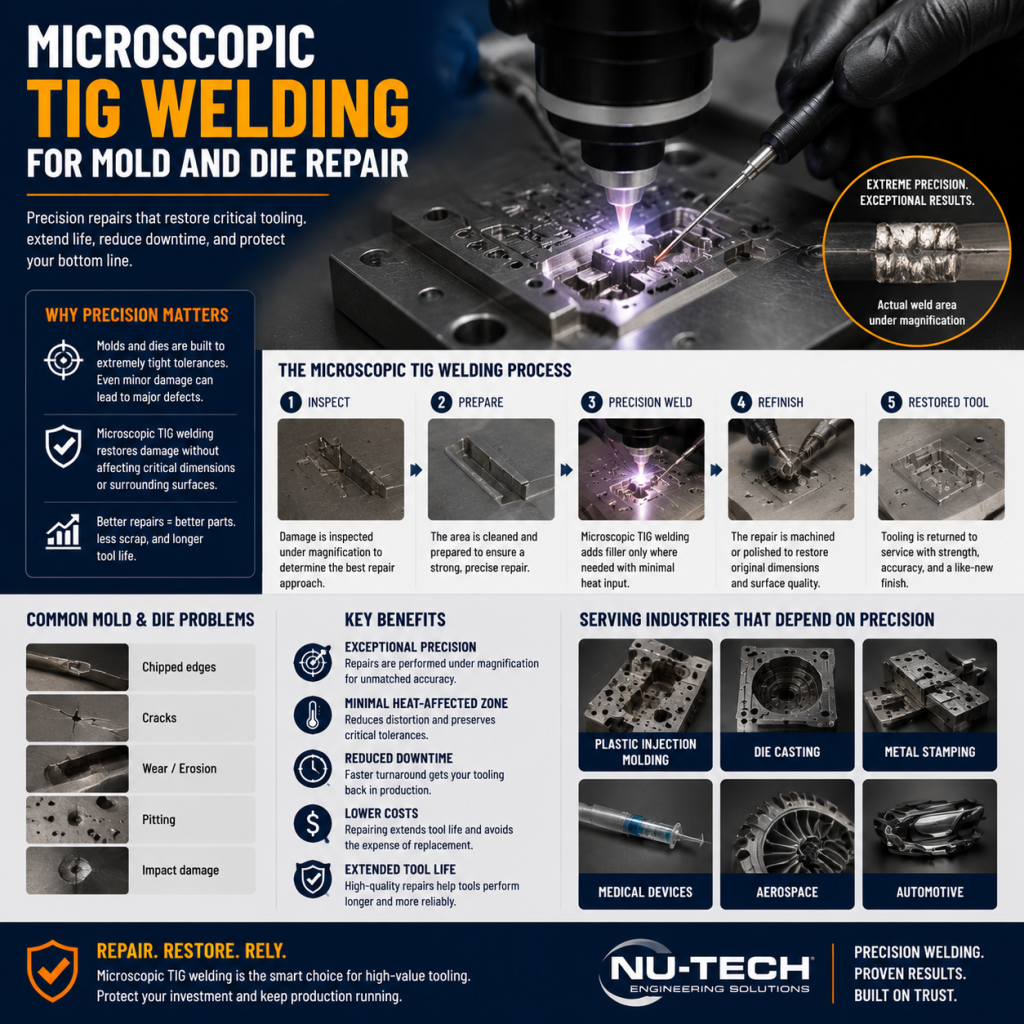
 Molds and dies are among the most valuable assets in modern manufacturing. Whether producing plastic components, stamped metal parts, or precision-engineered products, these tools are expected to maintain extremely tight tolerances while enduring thousands—or even millions—of production cycles.
Over time, however, wear, small cracks, chipped edges, and surface damage can reduce product quality and lead to costly downtime. Replacing an entire mold or die is often expensive and time-consuming, which is why many manufacturers turn to microscopic TIG welding for precision repairs.
In this article, we’ll explore how microscopic TIG welding supports mold and die repair, why it’s preferred for delicate restoration work, and how it helps extend the life of high-value tooling.
What Is Microscopic TIG Welding?
Microscopic TIG welding is a highly controlled welding process performed under magnification. It allows technicians to make extremely precise welds on small or intricate metal components while minimizing heat input to the surrounding material.
The combination of precision equipment and magnified visibility makes microscopic TIG welding ideal for repairing tooling that demands exceptional accuracy.
Unlike conventional welding methods, microscopic TIG welding enables technicians to restore damaged areas without significantly affecting nearby surfaces or critical dimensions.
Why Mold and Die Repair Requires Precision
Manufacturing molds and dies are designed with exact dimensions to produce consistent, high-quality parts.
Even minor defects can lead to problems such as:
- Flashing
- Dimensional inaccuracies
- Surface imperfections
- Poor part fit
- Increased scrap rates
- Premature tooling failure
Repair methods must preserve the original geometry of the tool while restoring strength and functionality.
Microscopic TIG welding offers the precision needed to accomplish both objectives.
Common Mold and Die Problems
Production tooling experiences constant mechanical stress during operation.
Common issues include:
- Chipped edges
- Small cracks
- Surface wear
- Erosion
- Impact damage
- Pitting
- Rounded corners
- Localized material loss
Many of these defects can be repaired without replacing the entire tool.
How Microscopic TIG Welding Restores Tooling
During the repair process, technicians carefully deposit filler material only where needed.
Because the weld is performed under magnification, repairs can be made with exceptional control.
This allows damaged features to be rebuilt while minimizing unnecessary material addition.
Once welding is complete, the repaired area can be machined, polished, or finished to restore the tool’s original dimensions and surface quality.
Benefits of Microscopic TIG Welding for Mold and Die Repair
Exceptional Precision
The greatest advantage of microscopic TIG welding is its accuracy.
Technicians can target extremely small defects while maintaining tight tolerances throughout the repair.
This precision is especially valuable for tooling used in:
- Injection molding
- Die casting
- Metal stamping
- Precision machining
- Medical device manufacturing
Reduced Heat-Affected Zone
Excessive heat can distort precision tooling.
Microscopic TIG welding uses localized, controlled heat that helps minimize thermal effects on surrounding material.
This helps preserve the integrity of critical surfaces and dimensional accuracy.
Extending Tool Life
Replacing molds and dies represents a significant investment.
Repairing localized damage allows manufacturers to continue using valuable tooling for longer periods, improving return on investment and reducing capital expenditures.
Reduced Downtime
Waiting for replacement tooling may delay production schedules.
Precision repair often allows manufacturers to return tools to service much faster than sourcing or manufacturing new ones.
This helps minimize downtime and maintain production efficiency.
Lower Manufacturing Costs
Repairing rather than replacing tooling can significantly reduce:
- Replacement costs
- Production interruptions
- Material waste
- Scrap
- Emergency tooling expenses
For many manufacturers, repairing existing tooling is the most economical option.
Applications Across Manufacturing Industries
Microscopic TIG welding supports mold and die repair in a wide range of industries.
Plastic Injection Molding
Injection molds can develop wear at gates, parting lines, and cavity surfaces.
Precision welding restores these areas while maintaining dimensional accuracy.
Metal Stamping
Stamping dies experience repeated impact that can lead to chipping and edge wear.
Microscopic TIG welding helps rebuild damaged areas with minimal distortion.
Die Casting
Die casting molds operate under high temperatures and pressures.
Localized repairs can restore worn surfaces without replacing the entire die.
Medical Device Manufacturing
Medical tooling often requires extremely fine features and tight tolerances.
Microscopic TIG welding allows repairs without compromising precision.
Aerospace Manufacturing
Aerospace tooling must meet demanding quality standards.
Precision repair helps extend tooling life while maintaining strict dimensional requirements.
Why Precision Matters
Small defects can have large consequences.
An improperly repaired tool may produce thousands of defective parts before the problem is discovered.
Microscopic TIG welding helps ensure repairs are accurate, repeatable, and compatible with the original tooling geometry.
This level of precision contributes to:
- Consistent part quality
- Reduced scrap
- Improved production efficiency
- Longer tooling life
Repair vs. Replacement
When evaluating damaged tooling, manufacturers often ask whether repair or replacement is the better option.
In many situations, repair offers significant advantages:
Repair Benefits
- Lower cost
- Faster turnaround
- Reduced downtime
- Extended tool life
- Minimal disruption to production
Replacement may still be necessary for severely damaged or worn-out tooling, but many localized defects can be restored successfully using microscopic TIG welding.
Choosing an Experienced Precision Welding Partner
Successful mold and die repair depends on more than the welding process itself.
An experienced provider understands:
- Tool steel characteristics
- Precision welding techniques
- Heat control
- Dimensional accuracy
- Surface finishing requirements
- Manufacturing tolerances
Working with a qualified microscopic TIG welding specialist helps ensure repairs restore both functionality and performance.
Conclusion
Microscopic TIG welding has become an essential repair method for molds and dies used in modern manufacturing. Its ability to restore localized damage with exceptional precision allows manufacturers to extend tooling life, reduce downtime, improve product quality, and lower overall production costs.
For industries where precision tooling represents a major investment, microscopic TIG welding provides an efficient, cost-effective alternative to complete replacement. By repairing high-value molds and dies before minor defects become major failures, manufacturers can maximize productivity while protecting one of their most important assets.