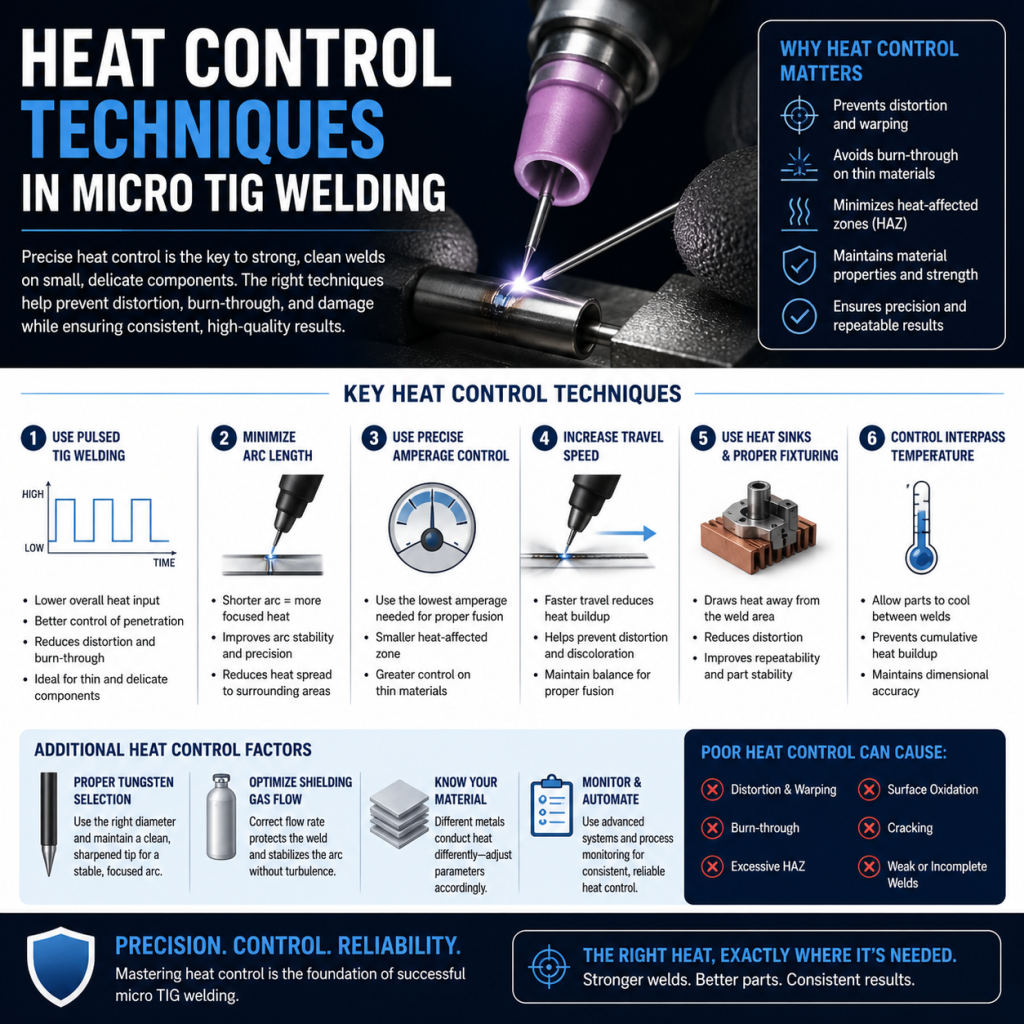
 Heat Control Techniques in Micro TIG Welding
Micro TIG welding is widely used in industries where precision is critical, including medical device manufacturing, aerospace, electronics, instrumentation, and defense applications. Unlike conventional welding, micro TIG welding often involves extremely small components, thin materials, and tight tolerances. In these situations, effective heat control is not simply important—it is essential.
Excessive heat can cause distortion, burn-through, metallurgical changes, and cosmetic defects. Insufficient heat can result in poor penetration, weak welds, and inconsistent quality. Mastering heat control techniques allows manufacturers to produce strong, reliable welds while protecting delicate components from damage.
Why Heat Control Matters in Micro TIG Welding
The challenge of micro TIG welding lies in balancing energy input with precision. Components being welded may be only fractions of a millimeter thick, leaving very little margin for error.
Proper heat control helps prevent:
- Material distortion
- Warping and dimensional changes
- Burn-through
- Excessive heat-affected zones (HAZ)
- Surface discoloration
- Cracking and metallurgical defects
- Damage to nearby components
By carefully managing heat input, welders can maintain the integrity of both the weld and the surrounding material.
Understanding Heat Input
Heat input refers to the amount of thermal energy introduced into the workpiece during welding.
Several factors influence heat input, including:
- Welding current (amperage)
- Arc duration
- Travel speed
- Arc length
- Pulse settings
- Material thickness
- Material thermal conductivity
Successful micro TIG welding requires careful adjustment of these variables to achieve the desired weld without overheating the assembly.
Using Pulsed TIG Welding
One of the most effective heat control techniques in micro TIG welding is pulsed current.
Rather than maintaining a constant welding current, pulsed TIG alternates between a higher peak current and a lower background current.
Benefits of Pulsed TIG
- Reduced overall heat input
- Improved weld appearance
- Better control of weld penetration
- Lower risk of distortion
- Reduced burn-through on thin materials
- Enhanced precision on miniature components
The peak current provides sufficient energy for fusion, while the background current allows the material to cool slightly between pulses.
This approach is particularly valuable when welding thin stainless steel, nickel alloys, titanium, and other sensitive materials.
Minimizing Arc Length
Arc length has a significant impact on heat concentration.
A shorter arc length:
- Concentrates heat more precisely
- Improves arc stability
- Produces narrower weld beads
- Reduces unnecessary heat spread
Maintaining a consistent, controlled arc length allows welders to focus energy exactly where it is needed while minimizing heat transfer to surrounding areas.
Precise Amperage Control
Micro TIG welding often requires extremely low amperage settings compared to conventional welding operations.
The goal is to use only the amount of current necessary to achieve proper fusion.
Benefits of lower amperage include:
- Smaller heat-affected zones
- Reduced distortion
- Improved control on thin materials
- Better cosmetic appearance
Modern micro TIG systems often feature highly accurate power supplies capable of delivering stable current at very low amperage levels.
Increasing Travel Speed
Travel speed directly affects how much heat accumulates in a weld area.
Moving too slowly can result in:
- Excessive heat buildup
- Larger heat-affected zones
- Material warping
- Surface oxidation
A properly controlled travel speed reduces thermal exposure while still allowing sufficient fusion and penetration.
Finding the right balance between speed and weld quality is essential for successful micro welding applications.
Utilizing Heat Sinks and Fixturing
Heat sinks are often used to draw excess heat away from sensitive components during welding.
Common heat sink materials include:
- Copper
- Aluminum
- Specialized thermal fixtures
Proper fixturing provides additional benefits:
- Improved dimensional stability
- Reduced distortion
- Better repeatability
- Enhanced production consistency
In precision manufacturing environments, custom fixturing is often an important part of the welding process.
Managing Interpass Temperature
For assemblies requiring multiple welds, controlling interpass temperature is critical.
Allowing components to cool between weld passes can:
- Reduce cumulative heat buildup
- Prevent distortion
- Improve metallurgical properties
- Maintain dimensional accuracy
Monitoring and controlling interpass temperature is especially important when working with heat-sensitive materials and high-value components.
Selecting the Proper Tungsten Electrode
The tungsten electrode plays an important role in controlling heat concentration.
Smaller diameter electrodes can provide:
- More focused arcs
- Greater precision
- Reduced heat spread
- Improved control on miniature welds
Proper electrode preparation also contributes to arc stability and consistent heat delivery.
A well-ground tungsten tip allows for a tighter arc and more accurate energy placement.
Optimizing Shielding Gas Flow
Shielding gas primarily protects the weld from atmospheric contamination, but it also influences heat characteristics.
Proper gas flow helps:
- Stabilize the arc
- Improve weld quality
- Reduce oxidation
- Enhance consistency
Excessive gas flow can create turbulence, while insufficient flow may allow contamination. Both conditions can negatively affect heat control and weld quality.
Material-Specific Heat Management
Different materials respond differently to heat.
Stainless Steel
Stainless steel generally responds well to micro TIG welding but can experience discoloration and distortion if heat input is excessive.
Titanium
Titanium requires careful heat management and shielding because elevated temperatures increase the risk of contamination.
Nickel Alloys
Nickel-based materials often require precise heat control to maintain mechanical properties and prevent cracking.
Thin-Gauge Components
Extremely thin materials demand meticulous control of amperage, pulse settings, and travel speed to avoid burn-through.
Understanding the thermal characteristics of each material helps optimize welding parameters.
Advanced Monitoring and Automation
Modern micro TIG welding systems increasingly incorporate advanced monitoring technologies.
These systems may include:
- Digital process controls
- Precision pulse programming
- Weld parameter recording
- Automated positioning systems
- Real-time process monitoring
Automation helps maintain consistent heat control across production runs and reduces operator variability.
Common Heat-Related Welding Defects
Poor heat control can lead to several quality issues.
Excessive Heat
May cause:
- Distortion
- Burn-through
- Large heat-affected zones
- Surface oxidation
- Material degradation
Insufficient Heat
May result in:
- Lack of fusion
- Weak joints
- Incomplete penetration
- Reduced mechanical strength
Proper process development helps eliminate these issues before production begins.
Why Heat Control Is the Foundation of Micro TIG Welding
Precision welding demands precision heat management. In micro TIG welding, even minor variations in thermal input can affect weld quality, dimensional accuracy, and component performance.
Techniques such as pulsed current welding, precise amperage control, optimized travel speed, heat sinks, advanced fixturing, and careful material selection allow manufacturers to achieve consistent, high-quality results.
As products continue to become smaller, more complex, and more demanding, effective heat control will remain one of the most important factors in successful micro TIG welding operations.