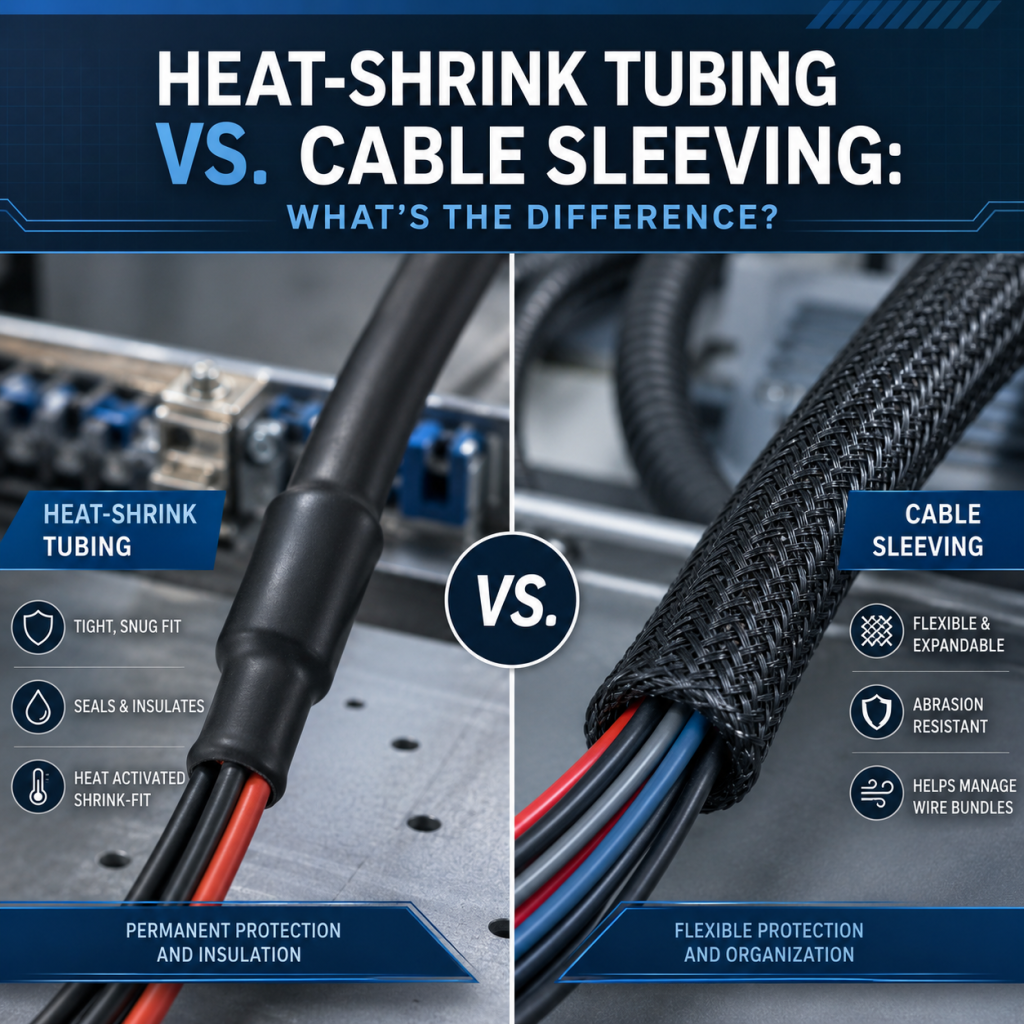
 When protecting wires and cables, two of the most common solutions are heat-shrink tubing and cable sleeving. While both help safeguard electrical systems and wire harnesses, they serve different purposes and perform differently in demanding environments.
Choosing the right option can improve cable longevity, reduce maintenance costs, and prevent premature failures. In this guide, we’ll compare heat-shrink tubing and cable sleeving, explain their advantages, and help you determine which solution is best for your application.
What Is Heat-Shrink Tubing?
Heat-shrink tubing is a specially manufactured polymer tube that shrinks when heat is applied. Once installed over a wire, cable, connector, or splice, the tubing contracts to form a tight, protective covering.
Heat-shrink tubing is commonly used to:
- Insulate electrical connections
- Protect cable splices
- Seal out moisture and contaminants
- Provide strain relief
- Improve abrasion resistance
- Protect connectors and terminations
Depending on the application, heat-shrink tubing may be available in standard, adhesive-lined, dual-wall, or high-ratio configurations.
What Is Cable Sleeving?
Cable sleeving is a protective covering designed to organize and shield groups of wires and cables. Unlike heat-shrink tubing, sleeving does not permanently shrink around the cable assembly.
Instead, it acts as a flexible outer layer that can expand and contract to accommodate multiple wires while still providing protection.
Cable sleeving is commonly used to:
- Organize wire bundles
- Reduce abrasion
- Improve cable management
- Protect against wear and vibration
- Enhance appearance and routing
- Simplify maintenance and future modifications
Braided sleeving is among the most popular styles because it is lightweight, flexible, and easy to install.
The Key Difference
The biggest difference between heat-shrink tubing and cable sleeving is how they fit around the cable.
Heat-shrink tubing creates a tight, permanent fit.
After heat is applied, the tubing conforms closely to the cable, splice, or connector beneath it.
Cable sleeving provides flexible, non-permanent protection.
It surrounds cables without sealing tightly to them, making it easier to remove, replace, or modify wire bundles later.
Heat-Shrink Tubing Benefits
Heat-shrink tubing offers several advantages for demanding electrical and industrial applications.
Superior Insulation
Because heat-shrink tubing fits tightly around wires and connections, it provides excellent electrical insulation and protection.
Environmental Protection
Many heat-shrink products are designed to resist:
- Moisture
- Dirt
- Dust
- Chemicals
- Corrosion
Adhesive-lined heat-shrink tubing can create an even stronger environmental seal.
Strain Relief
Heat-shrink tubing helps reinforce cable transitions and connector areas where repeated movement could otherwise cause damage.
Professional Appearance
A properly installed heat-shrink sleeve creates a clean, finished look while improving reliability.
Cable Sleeving Benefits
Cable sleeving excels in applications where flexibility and cable organization are priorities.
Easy Installation
Most sleeving products can be installed without specialized tools or heat sources.
Simplified Maintenance
Since sleeving does not permanently attach to cables, technicians can easily access wires for inspection, repair, or upgrades.
Wire Bundle Management
Cable sleeving helps keep multiple wires organized and protected while reducing clutter.
Abrasion Protection
Braided sleeving provides excellent resistance to rubbing and wear in high-vibration environments.
When Should You Use Heat-Shrink Tubing?
Heat-shrink tubing is often the best choice when you need:
- Electrical insulation
- Environmental sealing
- Moisture protection
- Connector protection
- Cable splice protection
- Permanent cable repairs
- Strain relief
Industries that frequently use heat-shrink tubing include:
- Aerospace
- Defense
- Marine
- Telecommunications
- Transportation
- Industrial manufacturing
- Energy and utilities
When Should You Use Cable Sleeving?
Cable sleeving is often preferred when you need:
- Wire organization
- Flexible cable management
- Abrasion protection
- Easy access for maintenance
- Protection for large wire bundles
- A clean, professional appearance
Common applications include:
- Control panels
- Machinery wiring
- Automotive harnesses
- Robotics
- Data centers
- OEM equipment manufacturing
Can Heat-Shrink Tubing and Cable Sleeving Be Used Together?
Absolutely.
Many industrial cable assemblies use both products to maximize protection.
For example, a wire harness may be covered with braided cable sleeving for overall protection and organization, while heat-shrink tubing is installed at the ends to secure the sleeving, protect transitions, and seal critical connection points.
This combination delivers the flexibility of sleeving with the durability and sealing performance of heat-shrink tubing.
Which Solution Is Right for Your Application?
The right choice depends on your specific requirements.
Choose heat-shrink tubing when insulation, sealing, strain relief, and permanent protection are your priorities.
Choose cable sleeving when flexibility, wire management, abrasion resistance, and future accessibility are most important.
In many cases, the best solution is not one or the other—but a combination of both.
Conclusion
Although heat-shrink tubing and cable sleeving are often mentioned together, they solve different challenges. Heat-shrink tubing provides a tight, durable, protective barrier that insulates and seals. Cable sleeving offers flexible protection that helps organize and protect wire bundles without permanently enclosing them.
Understanding the strengths of each solution allows engineers, technicians, and maintenance teams to build more reliable cable systems while reducing downtime and extending service life.
If you’re unsure which option is best for your application, working with an experienced cable protection supplier can help ensure you select the right product for long-term performance.
Heat-Shrink Tubing vs. Cable Sleeving: What’s the Difference?